AI Overviews Visibility: 5 Steps to Align with Google's New Optimization Rules
AI Overviews visibility has exactly two technical requirements: your page must be indexed and it must be eligible to show a snippet in Google Search. Google's AI features documentation, updated in September 2026, states there are no additional requirements and no special optimizations needed bey...
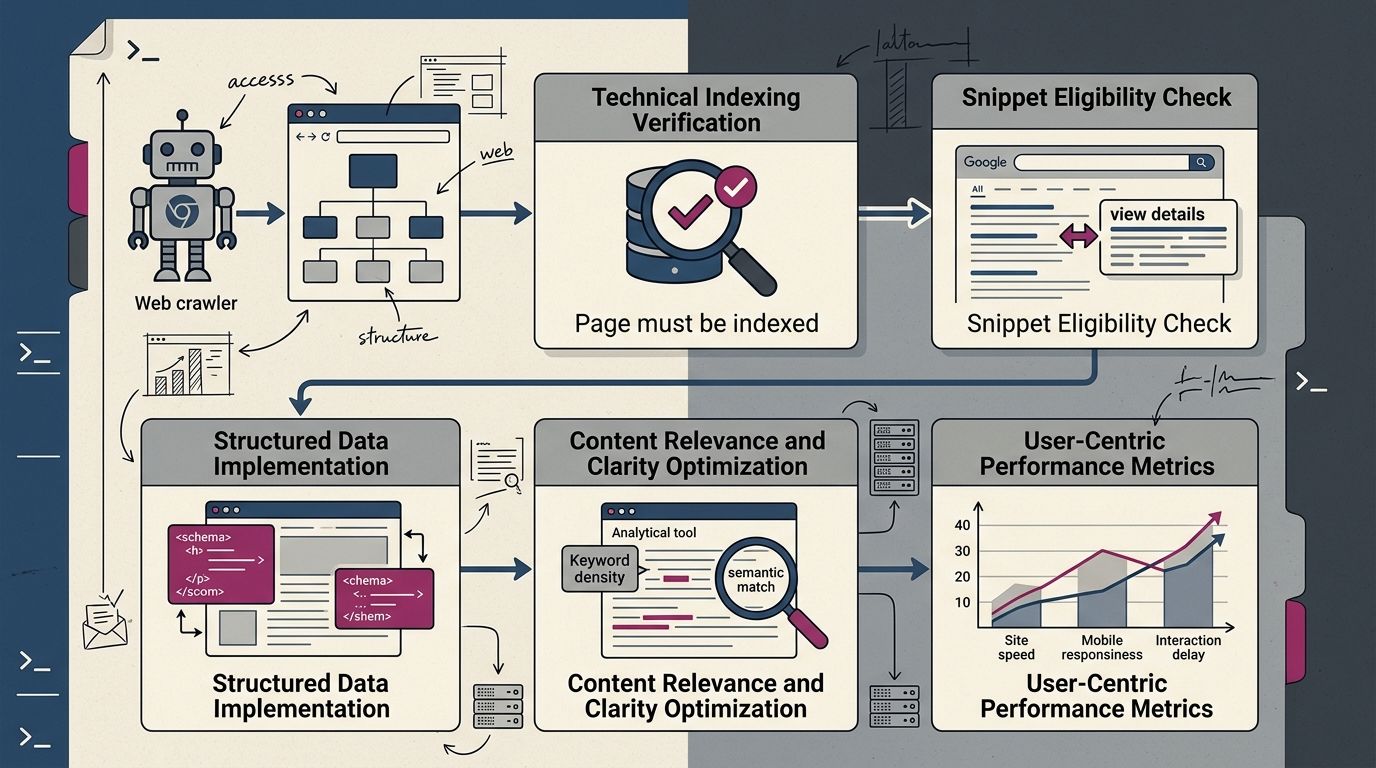
AI Overviews visibility has exactly two technical requirements: your page must be indexed and it must be eligible to show a snippet in Google Search. Google's AI features documentation, updated in September 2026, states there are no additional requirements and no special optimizations needed beyond that.
Sources: Google Search Central, AI Features and Your Website. Written by ADpilot OU, Tallinn, running our own machine on our own blog.
Table of Contents
- What You Need Before Starting
- The Snippet-Eligible Answer Loop: Our AI Overviews Visibility Framework
- Step 1: Confirm Indexing and Snippet Eligibility
- Step 2: Answer the Query in the First 45 Words
- Step 3: Build Headings Around Real Questions, Then Gate the Draft
- Step 4: Extend AI Overviews Visibility Past Google
- Step 5: Decide Deliberately What You Block
- What 79 EUR a Month on Growth Actually Buys
- How to Verify You Did It Right
- Frequently Asked Questions
What You Need Before Starting
79 EUR a month buys the loop that runs these five steps: (1) index check, (2) answer-first draft, (3) 8 quality gates, (4) your approval, (5) publish to 17 platforms plus your blog. Brand setup takes under an hour.
Before Step 1, you need four things in place. A site you control and can publish to. A verified Google Search Console property. A list of the questions your buyers actually type. And a decision about whether you want to appear inside AI answers at all, because since September 2026 that is a separate choice from appearing in regular Search results.
AI Overviews visibility: the state of a page being indexed, snippet-eligible and selected as a supporting link inside Google's AI Overviews or AI Mode answer for a given query.
You do not need structured data to start. You do not need a page-one ranking. Both are widely repeated in optimization guides written through 2025 and neither appears as a requirement in Google's own AI features documentation. We check that page every quarter because the advice around it moves faster than the documentation does.
One honest limit up front. Nothing in this article guarantees citation inclusion. Google publishes no percentage, no threshold and no scorecard for AI Overviews visibility. What it publishes is an eligibility condition and that condition is the only part of this you fully control.
The Snippet-Eligible Answer Loop: Our AI Overviews Visibility Framework
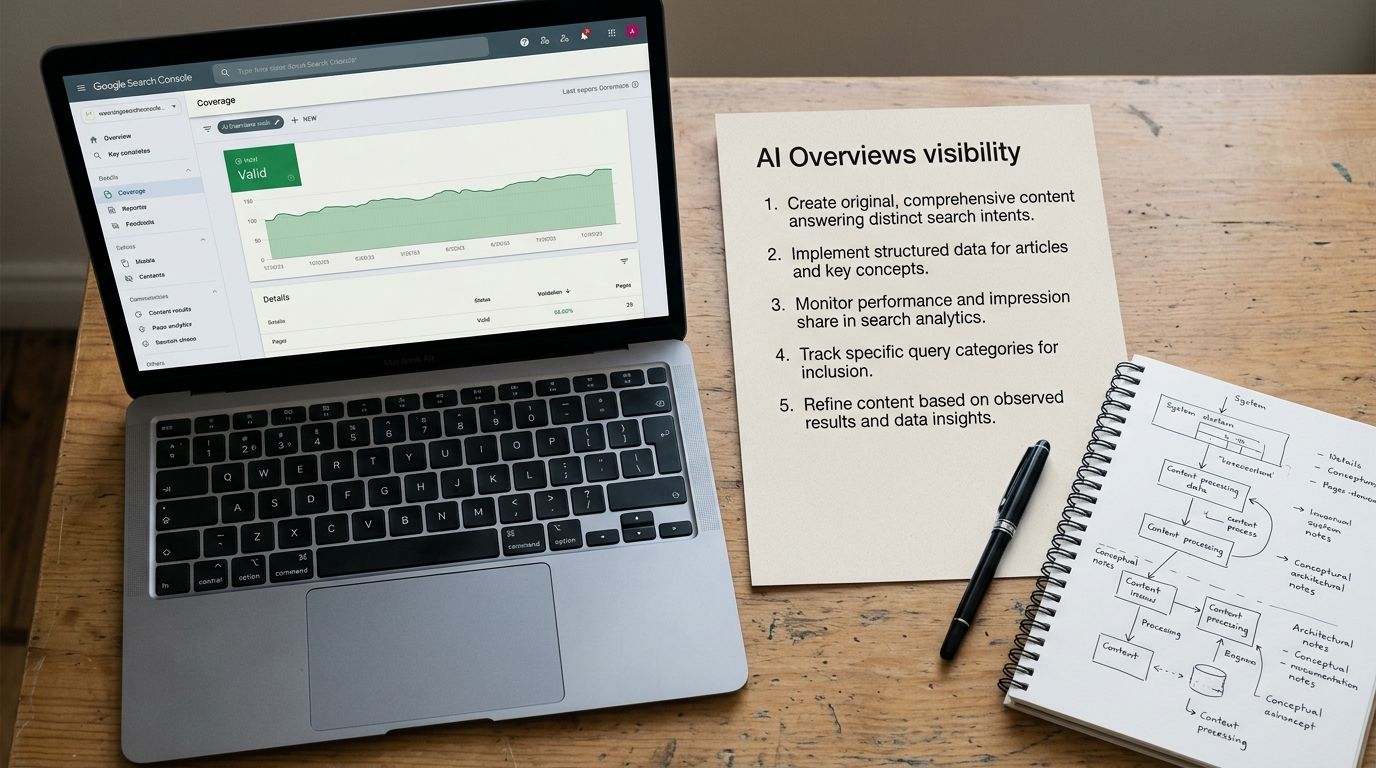
The Snippet-Eligible Answer Loop: a four-part publishing cycle that keeps pages indexed, answer-first, question-structured and measured in Search Console, then redrafts the pages that slip out of the citation set.
The loop has four positions. Eligibility, which is technical. Answer, which is the first 45 words. Structure, which is your H2 and H3 layout. Signal, which is what Search Console reports back. Each position feeds the next and the fourth position feeds the first again.
We built ADpilot around this loop because the alternative is a checklist you run once and forget. Checklists decay. A loop that re-reads its own Search Console data does not.
Here is why the order matters. An article with a brilliant answer block on a page that isn't snippet-eligible has zero AI Overviews visibility. The reverse is also true: a perfectly indexed page that buries its answer at paragraph nine rarely gets pulled into an overview. Eligibility is necessary. The answer block is what makes the page useful to lift.
One industry dataset, tracked by Advanced Web Ranking and updated 31 August 2026, reported AI Overviews appearing in 75.24% of personalized U.S. search results and 64.99% of non-personalized results across 8,000 keywords. That's third-party measurement, not official Google data and we treat it as directional. Directionally, it says the surface is not a niche anymore.
Our trend agent HTTP-verifies every source it reads before a draft is allowed to cite it. That rule exists because half the AI search commentary circulating since 2025 cites pages that no longer resolve. If you want the fuller argument on tool selection. We wrote about what an AI SEO tool should cost and what it has to prove.
Step 1: Confirm Indexing and Snippet Eligibility
Action first: open Search Console, run the URL Inspection tool on your ten most important pages and confirm each one returns "URL is on Google" with no snippet-blocking directive in the HTML.
Snippet eligibility: the condition of a page being allowed to display a text excerpt in Google Search, controlled by nosnippet, data-nosnippet, max-snippet and noindex directives.
Google's documentation is direct on this point: to be eligible as a supporting link in AI Overviews or AI Mode, a page must be indexed and eligible to be shown in Google Search with a snippet. That's the whole gate. Everything after Step 1 improves your odds inside the eligible set, not your entry to it.
Three failures we see constantly. A max-snippet:0 left over from a 2025 experiment. A noindex on a staging template that shipped to production. A robots.txt disallow on a directory that also holds your best answer pages. Each one removes AI Overviews visibility silently and none of them throw an error.
Check these four things on every page you care about:
- Index status in Search Console shows the page on Google
- No
noindexmeta tag in the head - No
nosnippetormax-snippet:0directive - No
data-nosnippetwrapper around the answer paragraph itself
The fourth one is the sneaky one. Teams wrap pricing blocks or summaries in data-nosnippet to stop competitors scraping, then wonder why their clearest answers never appear in an overview. Google documents these controls on its snippet controls page and industry reporting says they can also affect what shows inside AI features.
ADpilot publishes to your blog with clean, indexable markup and no snippet suppression by default. It does not fix a misconfigured CMS for you. If your theme injects noindex, that's a developer job and we'd rather tell you that than pretend the machine handles it.
Step 2: Answer the Query in the First 45 Words
Action first: rewrite the opening of every target page so the first two sentences answer the exact question in the title, in under 45 words, with no preamble.
Most people believe AI Overviews visibility depends on a longer, more thorough page. The data points the other way. Google's guidance emphasizes people-first content that satisfies the query directly and the practical pattern across current optimization guidance is a short, self-contained answer at the top. Length is what you add after the answer, not instead of it.
The 40 to 60 word answer block is a third-party recommendation, not a Google rule. We use it anyway because it forces a clean, extractable unit. An answer that survives being cut out of the page is an answer an engine can lift.
Here's the structure we run on every article in our own queue:
- Bold the answer sentence. State the subject, the number and the date.
- Add one supporting sentence with the source named inline.
- Stop. No throat-clearing, no "in this article we will".
Through 2025, plenty of guides argued that engagement time on page was the lever. Engagement matters for humans. For citation inclusion, what matters is whether a passage stands alone as a correct, sourced answer. Our 5-axis truth score checks exactly that before a draft reaches you.
Do NOT open a page with a definition of the industry. If the query is "how do I check my AI visibility", the first sentence must start checking it. Pages that spend 200 words on context before the answer are the single most common pattern we reject at the gate stage.
One caveat. Answer-first formatting will not rescue a page nobody indexed and it won't manufacture authority you don't have. It makes an already-credible page easier to quote. That's the honest ceiling.
Step 3: Build Headings Around Real Questions, Then Gate the Draft
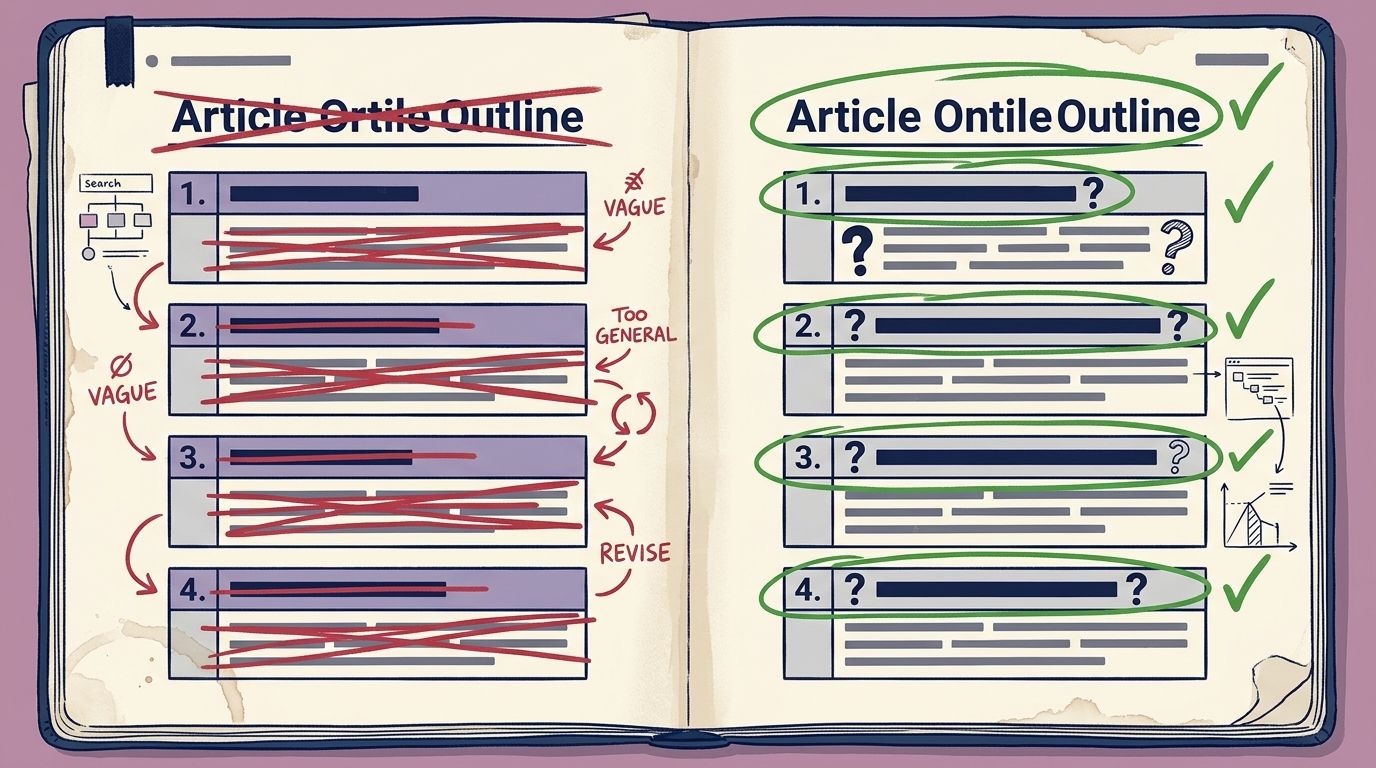
Action first: convert every H2 and H3 into a question or a direct action your reader would type, then run the draft through a quality check before it goes live.
Clear headings that mirror user questions are one of the most consistent recommendations across current AI Overviews optimization guidance. The mechanism is not mysterious. A heading that matches the query gives the retrieval system a labelled passage. A heading that says "Our Approach" gives it nothing.
Pull your headings from real demand, not from imagination. Search Console query data, People Also Ask boxes and the questions customers send you in email are all better sources than a keyword tool's autocomplete. We seed our own outlines from Search Console queries, which is how we learned which phrasings Google already surfaces us for.
Now the gate. Every ADpilot draft passes 8 quality gates before it reaches your approval queue. A 70+ humanity threshold. A 5-axis truth score. An AI-tell filter that strips the phrases that mark a page as machine-written. Compliance checks for 9 regulated verticals. If a draft fails, it gets redrafted, not published.
Why gates instead of volume? Because the failure mode of AI content tools is not bad grammar. It's confident, unsourced claims that quietly destroy the trust signals your AI Overviews visibility depends on. Google's published guidance is consistent that content should be made for people first, not primarily for ranking.
| Draft check | What it measures | Pass threshold | Best for |
|---|---|---|---|
| Humanity score | Sentence rhythm, hedging, filler density | 70+ | Avoiding AI-tell penalties |
| 5-axis truth score | Claim, source, date, number, attribution | All 5 axes clear | Citation-worthy accuracy |
| AI-tell filter | Known machine phrasing patterns | Zero flags | Readability and trust |
| Compliance gate | Rules for 9 regulated verticals | Vertical-specific | Finance, health, legal niches |
| Source verification | HTTP status of every cited URL | 200 response | Preventing dead-link citations |
The gates run on every draft on both plans. They aren't an upsell.
Step 4: Extend AI Overviews Visibility Past Google
Action first: pick the two non-Google engines your buyers actually use, then publish the same answer-first structure in the formats those engines read.
Google AI Overviews, AI Mode and Gemini are one surface. ChatGPT search, and Microsoft Copilot are others. They share a bias toward clean, sourced, extractable passages and they differ in how they discover you.
The clearest live example right now is local. Consultancy coverage published for 2026 documents local businesses actively chasing citation inside answers, with a practical emphasis on consistent entity information and pages that answer questions directly rather than pitch. Pleiades Consultancy's guide on getting cited by sits in that conversation, alongside a run of practitioner threads on X through 2026 making the same argument: engines cite sources that read like answers, not brochures.
We can't verify the citation counts individual practitioners report. We can verify that the structural advice matches what Google documents for its own AI features, which is a useful signal. When four engines converge on the same shape of page, that shape is the safer bet.
| Engine | Primary discovery path | What it favours | Best for |
|---|---|---|---|
| Google AI Overviews / AI Mode | Google index, snippet eligibility | Indexed, snippet-eligible pages answering informational queries | Broad reach on question queries |
| Live web retrieval plus index | Direct answers, clear entity data, recent dates | Local and niche service brands | |
| ChatGPT search | Web retrieval plus source reputation | Self-contained passages with named sources | Research and comparison queries |
| Copilot | Bing index | Structured pages, consistent brand mentions | B2B and workplace queries |
| Gemini | Google ecosystem, including Workspace surfaces | Same eligibility base as Search | Users inside Google products |
One Google-specific detail worth knowing: Workspace documentation notes that AI Overviews inside Gmail search require both smart features in Gmail, Chat and Meet and Workspace smart features to be switched on. Some of these surfaces are user-controlled, not publisher-controlled.
ADpilot publishes to 17 platforms plus your own blog, natively in 22 languages. That covers distribution and brand mentions across social and your site. It does not submit you to any AI engine, because no such submission exists. Anyone selling you direct placement inside an AI answer is selling something that isn't real.
For the measurement side of this, we broke down what the generative AI report hides and why share of voice across engines is still mostly estimated, not reported.
Step 5: Decide Deliberately What You Block
Action first: choose whether you want your content inside AI answers, then set the controls once and document the decision.
Block from AI features: a Search Console control described in industry reporting as added in June 2026 and available worldwide by 31 August 2026, letting publishers restrict content from AI surfaces.
In September 2026, Google announced that publishers can determine whether their sites appear in AI Mode and AI Overviews independently of regular Search results, according to 9to5Google's AI Overviews coverage. That's a meaningful split. Until this change, the practical trade-off many teams faced was all or nothing.
Who might block? Publishers whose revenue depends entirely on click-through and who have measured a real decline. One third-party guide cites a 58% CTR drop associated with AI Overviews in 2026. That number is unverified in the materials we reviewed and we'd treat it as a claim rather than a benchmark until someone publishes the methodology.
Who should not block? Almost every small brand we write for. If you have no audience yet, the citation surface is a discovery channel, not a leak. Zero-click search only costs you something when you already had the clicks.
A middle path exists. Use max-snippet limits on pages where you want brand mentions without full extraction. Leave your answer hubs fully open. Keep transactional pages snippet-eligible too, since AI Overviews visibility patterns across commercial queries are inconsistent in third-party analysis and not formally defined by Google.
Document whatever you choose. We keep our directive decisions in the same place as our publishing rules, because the most expensive SEO bugs are the ones nobody remembers introducing.
ADpilot does not set snippet controls for you. That's a deliberate limit. Directives that affect your entire site's AI Overviews visibility should be a human decision with a name attached.
What 79 EUR a Month on Growth Actually Buys
Growth is 79 EUR a month with a 7-day free trial. Scale is 99 EUR a month and adds SEO OS. Those are the two plans, billed through Stripe, self-serve, no sales call.
what the 79 EUR covers in plain terms and what it doesn't.
| Included on Growth (79 EUR/mo) | Not included on any plan |
|---|---|
| Trend agent with HTTP-verified sources | Guaranteed AI Overview citation |
| Long-form SEO articles in your learned voice | Paid ad spend or media buying |
| Platform-native social posts | Backlink outreach or link buying |
| 8 quality gates on every draft | Manual fixes to a broken CMS |
| 70+ humanity threshold, 5-axis truth score | Legal sign-off in regulated verticals |
| AI-tell filter and compliance for 9 verticals | Promised traffic or revenue numbers |
| Approval queue before anything publishes | Direct submission to any AI engine |
| Publishing to 17 platforms plus your blog | Snippet directive management |
| Native content in 22 languages | SEO OS (that's Scale, 99 EUR/mo) |
| Rank tracking through Google Search Console | Per-engine AI citation counts from Google |
The comparison that matters for a solo founder is not ADpilot against Jasper or Buffer. It's 79 EUR against the hours. Writing one answer-first article, verifying its sources, running it past a quality check and distributing it across platforms is a half-day of focused work if you're fast. Four of those a month is two days. At any freelance rate above 40 EUR an hour, the maths stops being close.
What we won't claim: that the machine replaces judgment. Every draft waits for your approval. That step exists because a brand voice you haven't reviewed is a brand voice you don't own.
The approval queue is also where the 70+ humanity threshold earns its place. Content that reads as machine-generated has been getting flagged and losing reach across platforms since 2025 and no amount of publishing volume recovers from that.
If you want the deeper measurement stack, GSC AI Mode metrics explain why fact-verified content behaves differently in those reports. For the reporting interface itself, start with our 2026 guide to the AI Overviews report.
How to Verify You Did It Right
Action first: run this five-point check 14 days after publishing, then again at 45 days.
You know Step 1 worked when URL Inspection returns "URL is on Google" and the live test shows no snippet restriction. That's binary. No interpretation needed.
You know Step 2 worked when you can paste your first 45 words into a document with no surrounding context and they still answer the question correctly. If the passage needs the paragraph above it to make sense, rewrite it.
You know Step 3 worked when your H2 list, read alone, looks like a list of search queries. Read the headings out loud with no body text. If they sound like a table of contents from a 2025 whitepaper, they're too abstract.
You know Step 4 worked when your brand name appears in answers from at least two engines for your core question. Ask the engines directly. Type your three main queries into Google AI Mode, and ChatGPT search and record which sources appear. Repeat monthly and track the change.
You know Step 5 worked when your directive decisions are written down, dated and match what's actually in your HTML.
Then check Search Console. Impressions on your answer pages are the closest first-party proxy for AI Overviews visibility that Google currently provides. Google's official documentation publishes no percentage for citation inclusion or traffic impact, so anyone quoting you a precise AI Overview citation rate is estimating.
Track three numbers monthly:
| Metric | Where to find it | Healthy direction | What it can't tell you |
|---|---|---|---|
| Indexed answer pages | Search Console coverage | Flat or rising | Whether they're cited |
| Impressions on question queries | Search Console performance | Rising | Which surface drove them |
| Manual engine checks | Google, ChatGPT | Brand appears in 2+ | Frequency across all users |
ADpilot pulls rankings from Google Search Console and redrafts pages that slip. That loop is the point. Publishing once and hoping is the failure mode we built against and it's why fact-verified content wins the overview more consistently than volume does.
Frequently Asked Questions
What is the 30% rule for AI?
There's no official Google rule at 30% for AI Overviews visibility. The phrase circulates in SEO communities as an informal heuristic, usually meaning roughly 30% of a page should be unique, first-hand material or that a brand should aim to appear in about 30% of tracked answer sets. Google's documentation defines no such threshold. The only numeric condition it publishes is that a page must be indexed and snippet-eligible.
How do I check my AI visibility?
Three methods, in order of reliability. First, Search Console impressions on question-shaped queries, which is first-party data. Second, manual checks: type your core queries into Google AI Mode, ChatGPT search and Copilot, then record which sources get cited. Third, third-party trackers that sample answers at scale, such as the datasets published by Advanced Web Ranking. None of them gives you a complete citation count, because Google doesn't publish one.
How to avoid AI Overviews?
Use snippet controls deliberately. Google documents nosnippet, data-nosnippet, max-snippet and noindex and industry reporting says these affect AI feature visibility as well as regular Search presentation. Since June 2026 a Search Console control described as "block from AI features" has also been available, reaching worldwide rollout by 31 August 2026. In September 2026 Google announced publishers can control AI Mode and AI Overviews appearance independently of Search. Weigh the trade-off honestly: blocking reduces AI Overviews visibility and may reduce discovery.
What is a good AI visibility score?
No official benchmark exists. Vendors sell scores but each uses a private formula, a private query set and a private weighting, so the numbers aren't comparable across tools. A more useful internal target: appear as a cited source for at least two engines on your five most commercially important questions and hold that position for 90 days. Measure your own trend rather than someone else's scale.
Does a page need to rank on page one to appear in AI Overviews?
No. That claim spread widely through 2025 guides and is unverified. Google's documentation states only that a page must be indexed and eligible to be shown in Google Search with a snippet. Ranking well and appearing in an overview correlate in third-party analysis but the documented requirement is eligibility, not position.
Is structured data required for AI Overviews visibility?
No. Schema markup is recommended in most optimization guides and it helps Google understand entities and page types. Google's AI features documentation does not list structured data as a special requirement for AI Overviews or AI Mode eligibility. Add it because it helps your knowledge graph and rich results, not because someone told you it's mandatory.
What does ADpilot cost and what does it not do?
Growth is 79 EUR a month with a 7-day free trial. Scale is 99 EUR a month and adds SEO OS. It drafts, gates, waits for your approval, publishes to 17 platforms plus your blog in 22 languages and tracks rankings through Search Console. It does not buy links, run ads, manage your snippet directives or guarantee citation in any AI answer.
Do AI Overviews appear on every query?
No. Third-party tracking from Advanced Web Ranking, updated 31 August 2026, reported AI Overviews in 75.24% of personalized U.S. results and 64.99% of non-personalized results across 8,000 keywords. Those figures are third-party, not official Google data. Informational and question-based queries trigger overviews more consistently than transactional ones in most published analysis, though Google hasn't formally defined that pattern.
The Short Version
AI Overviews visibility comes down to eligibility plus clarity. Get indexed, stay snippet-eligible, answer the query in the first 45 words, structure headings as questions and decide on purpose what you block. Then measure in Search Console and redraft what slips, because the citation set moves.
We run this loop on our own blog with our own machine and we publish what it doesn't do alongside what it does. If a tool promises you guaranteed placement inside an AI answer, close the tab.
Start your 7-day free trial at adpilot.ee/register
More from the Journal
Want a machine that writes like this for your brand?
Sign up