Surviving Google's CTR Drops: Hedging Search Volatility With 17 Platforms
Google CTR drops hardest when an AI Overview appears: desktop position 1 CTR fell from 20.02% to 9.69% in Advanced Web Ranking's July 2026 sample. Hedging that volatility means publishing beyond Google, to 17 platforms, so one SERP layout change can't erase a whole quarter of visibility. | Ques...
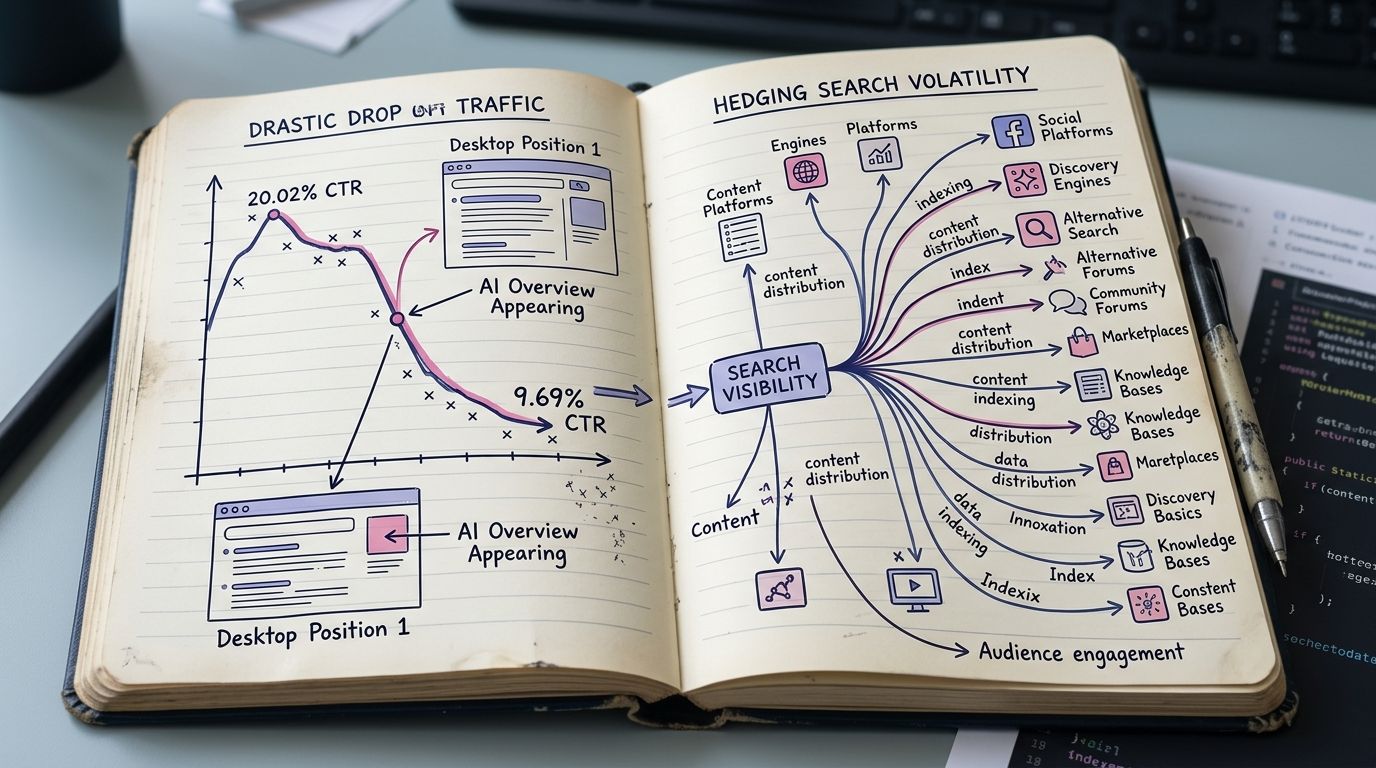
Google CTR drops hardest when an AI Overview appears: desktop position 1 CTR fell from 20.02% to 9.69% in Advanced Web Ranking's July 2026 sample. Hedging that volatility means publishing beyond Google, to 17 platforms, so one SERP layout change can't erase a whole quarter of visibility.
| Question | Answer as of 2026-09-30 |
|---|---|
| How often do AI Overviews appear? | 43% of Google US desktop SERPs (Advanced Web Ranking, July 2026) |
| What happens to position 1 CTR? | 20.02% without an AI Overview, 9.69% with one (AWR, 2026) |
| What happens to zero-click rate? | 53.6% without, 74.3% with (AWR, 2026) |
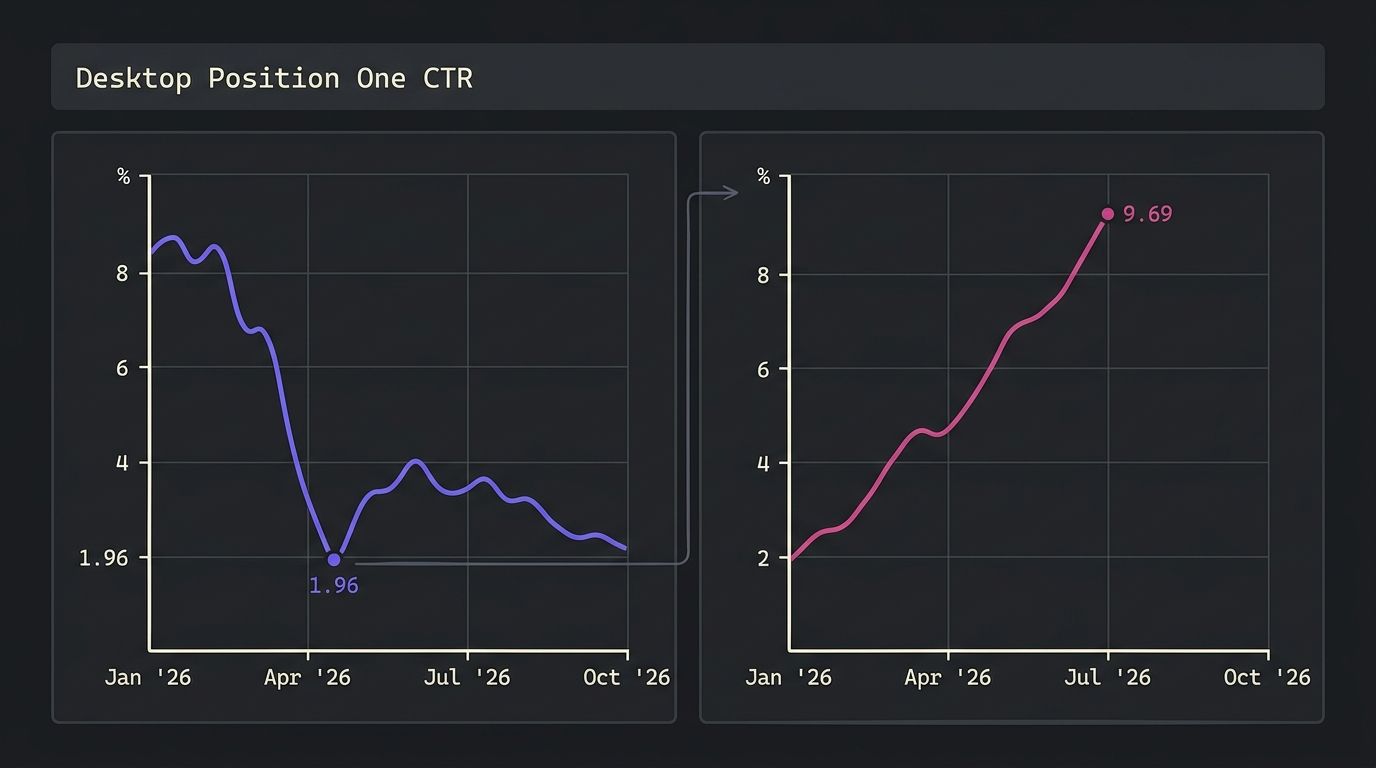
| Is the drop permanent? | No. Desktop position 1 CTR on AI Overview pages went 1.96% in April 2026 to 10.23% in June 2026 (Seer Interactive via Search Engine Journal, 2026) |
| What hedges it? | Publishing the same week's work to 17 platforms plus your own blog, not to Google alone |
To hedge Google CTR drops for 79 EUR a month: (1) publish to 17 platforms, (2) track rankings in Search Console, (3) redraft what slips. Takes one week.
Table of Contents
- What position.digital reported on September 26 and what we could not verify
- Google CTR drops by the numbers: five datasets in one table
- Most people believe position one is safe. The data shows otherwise
- Organic, paid and AI Overview: three different Google CTR drops
- Citation order beats ranking position in AI answers
- The Seventeen Doors Method for hedging search volatility
- ADpilot vs Buffer: an honest look at multi-platform publishing
- What we actually do in our own queue when Google CTR drops
- Frequently Asked Questions
What position.digital reported on September 26 and what we could not verify
AI Contribution: a reported Search Console pilot that would show publishers a monthly earnings figure when their content is used to generate AI answers.
On September 26, 2026, the position.digital AI SEO news roundup covered a Search Console pilot described under that name. The framing was simple: if your pages feed an AI answer, you'd see a number attached to that contribution.
Here's the honest part. We went looking for an official Google product announcement matching that description and could not confirm one in the sources we checked. Treat the pilot as reported, not as shipped policy. We're saying that out loud because the rest of this article rests on numbers that are verifiable and mixing the two would be sloppy.
The same applies to a figure circulating alongside the story: a 23.1 percent CTR decline for pages exposed to AI Overviews. We couldn't trace that specific number to a primary study in our source set. The declines we can trace are larger and we'll use those instead.
What we can verify is that Google itself has acknowledged reporting gaps. Search Engine Journal reported in September 2026 that Search Console's AI search reporting is inadequate and that AI Overviews are handled with "block flattening," meaning the classic position metric stops meaning what you think it means.
So the real story isn't a payment pilot. It's that Google CTR drops are now happening inside a measurement system that admits it can't fully describe them. If you're reading your traffic through one dashboard, you're reading a partial picture. We wrote more about that in our breakdown of what the generative AI report hides.
Google CTR drops by the numbers: five datasets in one table
Google CTR drops: a measurable fall in the share of searchers who click a result, expressed as clicks divided by impressions, usually triggered by a SERP layout change rather than a ranking change.
Nobody has put the major 2026 studies side by side with their dates and sample sizes. Here it is.
| Study | Published | Sample | Metric without AI Overview | Metric with AI Overview | Best for |
|---|---|---|---|---|---|
| Advanced Web Ranking organic CTR | July 2026 | Google US desktop SERPs, 43% AIO presence | Position 1: 20.02% | Position 1: 9.69% | Position-level benchmarking |
| AWR zero-click | July 2026 | Same dataset | 53.6% zero-click | 74.3% zero-click | Understanding lost demand |
| Seer Interactive via Search Engine Journal | Q2 2026 | Google US desktop | Positions 1+2: 29.05% | Positions 1+2: 10.04% | Top-two click concentration |
| Seer Interactive broad study | Jan 2025 to Feb 2026 | 53 brands, 5.47M queries, 2.43B impressions | Organic CTR 1.62% | Organic CTR 0.61% | Cross-brand averages |
| Search Engine Land recovery study | 2026 | Cited pages in AI Overviews | 1.3% (Dec 2025) | 2.4% (Feb 2026) | Recovery trend, cited pages |
Three things fall out of that table.
First, magnitude depends entirely on the dataset. AWR measures position-level CTR on tracked keyword sets and reports 20.02% to 9.69%. Seer measures across 53 brands and 2.43 billion impressions and reports 1.62% to 0.61%, roughly a 61% decline. Both are true. They're measuring different things.
Second, the drop is not a straight line down. AWR documented what it calls a spring 2026 shock: desktop position 1 CTR on AI Overview SERPs collapsed to 1.96% in April 2026, then recovered to 9.69% by July. Seer's numbers show the same shape, 1.96% in April and 10.23% in June 2026.
Third, zero-click behaviour is the cleanest signal. A 74.3% zero-click rate on AI Overview pages against 53.6% without one is a 20-point swing in whether a search produces a visit at all.
Most people believe position one is safe. The data shows otherwise
Most people believe ranking first protects you from Google CTR drops. The data shows the opposite: AWR's July 2026 study concluded the #1 organic result "loses half its clicks" when an AI Overview appears, falling from 20.02% to 9.69%. Lower positions bleed proportionally harder. Position 2 fell 64% and position 3 fell 56% in the same dataset. Rank is no longer a shield. Do not spend a quarter chasing position 1 on a query that renders an AI Overview 43% of the time.
That last line is the one that changes budgets. If you're a solo founder with ten hours a month for content, the old calculation said: win one keyword, own the traffic. The 2026 calculation says: winning that keyword may deliver less than half the clicks it delivered in 2024 and you won't know until the SERP renders.
Block flattening: Search Console's method of collapsing an AI Overview block into a single position value, which is why average position stops correlating cleanly with clicks on AI Overview queries (Search Engine Journal, 2026).
This is why we keep telling people to stop optimising for the position number. Search Engine Journal's coverage of block flattening put it plainly: focus on outcomes, not classic position metrics. Our own walkthrough of Google's AI Overviews report in Search Console covers which columns still tell you something useful and which have quietly stopped.
There's a second myth worth killing. AI Overviews don't always eliminate clicks. Cited pages still receive traffic and Search Engine Land reported AI Overview CTR on cited pages recovering from 1.3% in December 2025 to 2.4% in February 2026, an 85% increase in two months. The drop is real and the recovery is real. Both belong in the same sentence.
Organic, paid and AI Overview: three different Google CTR drops
Searchers conflate three separate problems. Most articles only address one. Here's the separation.
Organic CTR drop: fewer clicks per impression on blue-link results, driven by SERP features pushing results below the fold or answering the query outright.
Paid CTR drop: fewer clicks per impression on Google Ads, usually a bidding, quality score, ad copy or placement issue and separately affected when an AI Overview occupies the top of the page.
AI Overview click loss: impressions that never become clicks because the answer is complete on the SERP, showing up as a higher zero-click rate rather than a ranking change.
Seer-reported data summarised in industry coverage showed paid CTR also fell on AI Overview queries, not just organic. That matters for anyone running both. If your Google Ads CTR and your organic CTR dropped in the same week and your rankings didn't move, the SERP layout is the more likely cause than your ad copy.
The diagnostic order we use, in this sequence:
- Did average position change in Search Console? If no, it's not a ranking problem.
- Did impressions hold or rise while clicks fell? That's a layout problem, not a demand problem.
- Do the affected queries render an AI Overview when you search them logged out? That's your answer.
- Did paid CTR move on the same query set in the same window? That confirms SERP-level, not channel-level.
Revenue impact is the part nobody publishes. Clicks aren't the business metric. If an informational query lost 60% of its clicks but those visitors converted at 0.2%, the revenue loss is small. If a comparison query lost 30% of its clicks and those visitors converted at 4%, that's the one to fight for. We sort affected queries by conversion value before we touch a single draft.
Our note on fact-verified content and the Overview covers how we score which queries are worth defending.
Citation order beats ranking position in AI answers
AI Overview citation: a linked source inside the generated answer block, ranked in its own order, independent of the organic results below it.
First Page Sage's report on click-through rates by ranking position found that click share inside AI answers is concentrated at the top of the citation list, not spread evenly.
| Citation slot | CTR | Share of all AI answer clicks | What it means |
|---|---|---|---|
| Citation 1 | 5.2% | 39.7% | Nearly two in five AI answer clicks |
| Citation 2 | 3.1% | 23.7% | Still material, roughly 60% of slot 1 |
| Citation 3 | 1.9% | 14.5% | Diminishing fast |
| Citations 4+ | Not separately reported | Remaining ~22% | Long tail, low yield |
Read that next to the organic numbers. Citation 1 at 5.2% sits below the 9.69% that position 1 organic still earns on an AI Overview SERP but it's earned on top of whatever your organic position delivers. Seer data reported by Search Engine Journal showed pages cited in an AI Overview get more clicks than pages on the same results page that are not cited.
So the job splits in two. You want the organic ranking and the citation. Losing one doesn't automatically lose the other and winning both is where the compounding sits.
Being citable is a mechanical problem, not a creative one. Answer the question in the first 45 words. State facts atomically. Attribute every number to a named source with a year. Keep claims verifiable by a crawler that has three seconds of patience. Our five steps for AI Overviews visibility breaks the mechanics down further.
Here's our limit, stated honestly: nobody can guarantee a citation slot. We build for citability and we measure what lands. We don't sell placement, because placement isn't for sale.
The Seventeen Doors Method for hedging search volatility
The Seventeen Doors Method: publish every piece of the week's work to 17 platforms plus your own blog in the same approval cycle, so a single Google SERP change can only close one door out of eighteen.
The logic is insurance, not reach-chasing. When Google CTR drops 61% on a query set you don't control, the only variable you do control is how many other surfaces carry the same week's work. If Google is one of eighteen doors, a 61% drop on one door is roughly a 3% dent in your total distribution. If Google is your only door, it's a 61% dent in your quarter.
Three rules make it work.
Rule one: same week, not same file. A LinkedIn post and a blog article about the same trend are not the same asset. Cross-posting identical text to 17 platforms produces 17 weak posts. Each platform gets a native draft built for its format, then the long-form article carries the depth and the citations.
Rule two: one approval gate, not seventeen. Multi-platform publishing dies on review workload. If approving 18 pieces takes four hours, you'll stop by week three. The gate has to be one queue, one pass, yes or no.
Rule three: measure the doors separately. Search Console covers Google. Everything else needs its own read. A week where Google CTR drops and LinkedIn impressions double is a good week and you'll only know that if you're tracking both.
We run this on ourselves. This brand account is ADpilot marketing ADpilot with its own machine, which means every claim in this article about the loop comes from watching our own queue, not from a case study we commissioned.
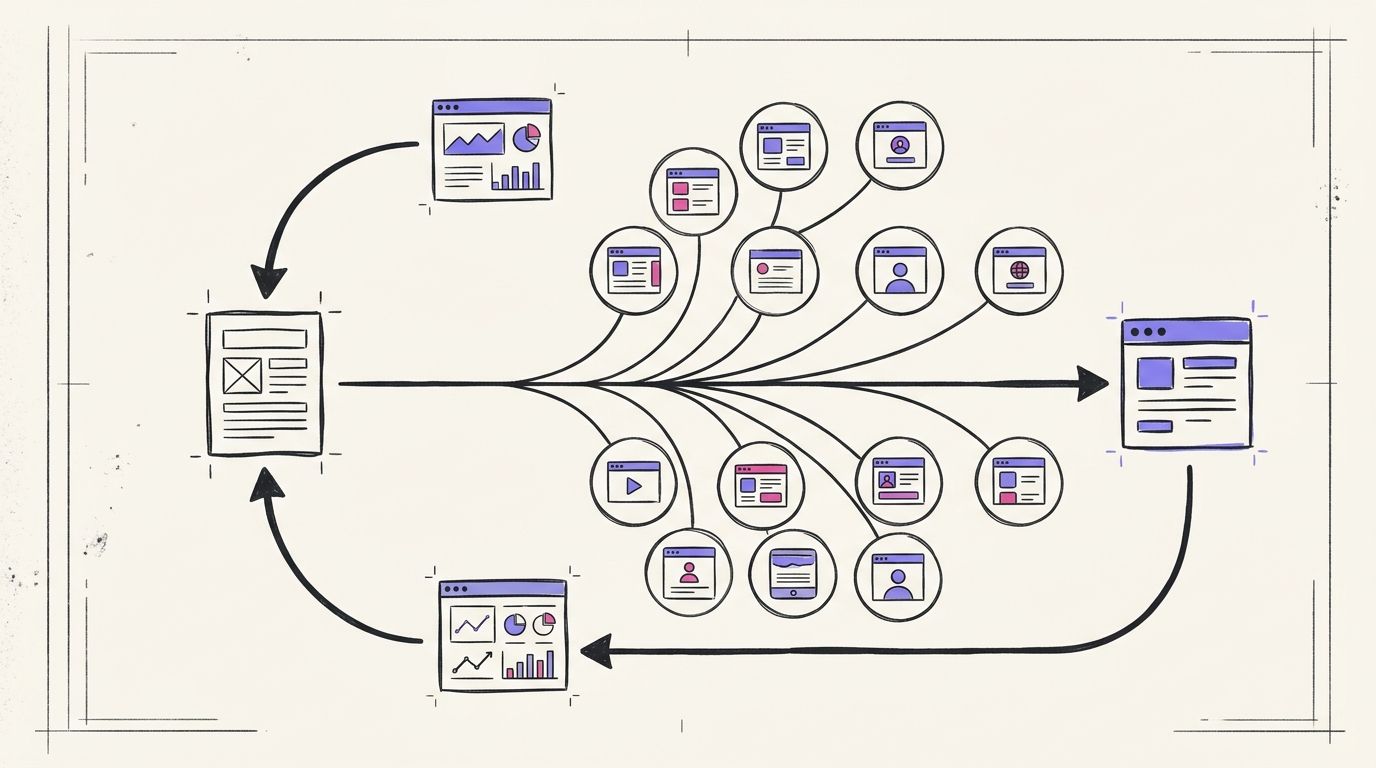
What this doesn't do: it doesn't replace a ranking. If the query matters and you're not on page one, seventeen social posts won't fix that. It reduces single-channel risk. That's the whole claim.
ADpilot vs Buffer: an honest look at multi-platform publishing
Buffer is the tool most people already use for multi-platform publishing, so it's the fair comparison. Everything below about Buffer comes from what Buffer publishes on its own site and we're describing categories rather than quoting prices, because per-channel rates change and you should read them on buffer.com directly rather than trusting a number in a blog post.
Per its own product pages, Buffer schedules and publishes social posts across a channel list that includes Instagram, Facebook, LinkedIn, X, TikTok, Pinterest, YouTube Shorts, Threads, Bluesky, Mastodon and Google Business Profile. It offers a free plan with a limited number of connected channels, an AI Assistant for drafting and repurposing, an engagement inbox, analytics and a Start Page link-in-bio. That's a solid, well-built social publishing tool and it does that job properly.
what it doesn't claim to do and we're only listing absences its own site doesn't advertise.
| Job to be done | Buffer (per its own site) | ADpilot | Best for |
|---|---|---|---|
| Social scheduling and queue | Yes, core product | Yes, 17 platforms | Tie |
| Pricing model | Per channel, per month, free tier available | Flat 79 EUR/month Growth, 99 EUR/month Scale | ADpilot at 8+ channels |
| Long-form SEO articles | Not part of the advertised product | Yes, published to your own blog | ADpilot |
| Search Console rank tracking | Not advertised | Yes, tracks rankings and redrafts what slips | ADpilot |
| Trend sourcing with HTTP-verified sources | Not advertised | Yes, sources verified before they're trusted | ADpilot |
| Quality gating before publish | AI Assistant drafts, human edits | 8 gates: 70+ humanity threshold, 5-axis truth score, AI-tell filter, compliance for 9 regulated verticals | ADpilot |
| Native writing in 22 languages | Not advertised as native multilingual generation | Yes, 22 languages | ADpilot |
| Engagement inbox and reply management | Yes | No, we don't do inbox | Buffer |
| Link-in-bio page | Yes, Start Page | No | Buffer |
| Free forever tier | Yes | No, 7-day free trial on Growth | Buffer |
The seat maths is the honest headline. Per-channel pricing scales linearly: ten channels costs roughly ten times one channel. A flat 79 EUR covers all 17 platforms plus your blog regardless of how many you connect. Below three or four channels, per-channel pricing usually wins on cost. Above eight, flat pricing usually wins. Run your own numbers against the live pricing page.
The bigger difference isn't price. Buffer distributes what you write. ADpilot decides what to write, writes it, gates it, waits for your approval, publishes it, then watches Search Console and redrafts the pieces that slip. If you already have a writer and just need scheduling, Buffer is the cleaner fit and we'll say so. If the writing is the bottleneck, scheduling software doesn't solve it. Our piece on what makes an AI SEO tool worth paying for covers how we'd evaluate either.
What we actually do in our own queue when Google CTR drops
A working response to Google CTR drops looks like this, in order, over one week.
Monday: separate layout from ranking. Pull the affected query set from Search Console. If impressions held and clicks fell, stop looking at your content and start looking at the SERP. Our guide to reading the AI Overviews report in Search Console covers the columns worth trusting.
Tuesday: sort by money, not by volume. Rank the affected queries by conversion value. Defend the top five. Let the rest sit. A query that lost 60% of a low-intent click stream isn't worth a rewrite.
Wednesday: rebuild the top five for citation, not for length. Put the answer in the first 45 words. Attribute every number to a named source and year. Add a comparison table. Remove the throat-clearing paragraph before the answer. The pattern that gets cited is atomic and sourced, per the recovery data Search Engine Land reported for cited pages.
Thursday: open the other doors. Take the same week's research and ship native drafts to the social platforms that carry your audience. Not identical text. Native formats.
Friday: set the recheck. AWR's spring 2026 shock and the June recovery show that a single month's data is a snapshot, not a trend. We recheck the same query set every 30 days before drawing any conclusion.
Two limits, stated plainly. This doesn't recover clicks from a query where Google now answers completely and nobody needs a source. And it won't outrun a genuine ranking loss, which shows up as falling impressions and average position, not just falling CTR.
We were wrong about one thing earlier in 2026: we assumed the April collapse was the new baseline. The July and June recoveries in both AWR and Seer data say otherwise. Volatility, not decline, is the condition. Build for volatility.
Frequently Asked Questions
What's a good CTR for Google Search?
It depends entirely on whether an AI Overview renders. On SERPs without one, Advanced Web Ranking reported 20.02% for desktop position 1 in July 2026. On SERPs with one, the same position averaged 9.69%. Across Seer's 53-brand dataset of 5.47 million queries, average organic CTR was 1.62% without an AI Overview and 0.61% with one, which shows how much query mix changes the benchmark.
Why has my Google ranking suddenly dropped?
Check whether your ranking actually dropped or your clicks did. If average position in Search Console is stable and impressions held while clicks fell, you're seeing Google CTR drops from a SERP layout change, not a ranking loss. If average position genuinely moved, look at a core update, a technical crawl issue or a competitor publishing something better on that query.
What could be causing a sudden drop in traffic in Google Analytics?
Four common causes, in the order we check them: a SERP feature change such as an AI Overview reducing CTR at stable rankings, a tracking or consent-banner change breaking measurement, a seasonal demand shift or a genuine ranking loss. Google CTR drops show up in Analytics as falling sessions while Search Console impressions stay flat, which is the fastest way to tell layout from ranking.
Is a 7% CTR good for YouTube?
YouTube impressions click-through rate is a different metric from Google Search CTR and isn't covered by the studies cited here. According to YouTube's own Studio benchmarking ranges, most channels sit in the low single digits to low double digits, so 7% is typically healthy. Don't compare it to Google Search CTR benchmarks, because the impression definition isn't the same.
Do AI Overviews always kill clicks?
No. Zero-click rate rose to 74.3% on AI Overview pages versus 53.6% without, per AWR's July 2026 data, so clicks fall substantially on average. But Search Engine Land reported AI Overview CTR on cited pages recovering from 1.3% in December 2025 to 2.4% in February 2026 and Seer data shows cited pages out-click uncited pages on the same results page.
Does being cited in an AI Overview actually pay?
Citation slot 1 earns 5.2% CTR and 39.7% of all AI answer clicks, per First Page Sage's 2026 report, dropping to 3.1% for slot 2 and 1.9% for slot 3. A reported Search Console pilot covered by position.digital on September 26, 2026 would attach a monthly earnings figure to AI contributions but we couldn't verify an official Google announcement, so treat it as unconfirmed.
Do paid campaigns suffer the same Google CTR drops?
Yes, per Seer-reported data summarised in industry coverage, paid CTR also fell on AI Overview queries. If your Google Ads CTR and organic CTR moved together on the same query set in the same week without a bid or copy change, the SERP layout is the more likely cause than anything in your account.
How many platforms should I publish to as a hedge?
Enough that no single channel carries more than a fifth of your distribution. ADpilot publishes to 17 platforms plus your own blog on one approval pass, which puts Google at roughly one eighteenth of your surface area. The point isn't reach for its own sake, it's that a 61% drop on one door costs you far less when there are seventeen others.
The short version
Google CTR drops are now a layout problem, not a ranking problem and the numbers vary by dataset: 20.02% to 9.69% at position 1 in AWR's July 2026 sample, 1.62% to 0.61% across Seer's 2.43 billion impressions. The April collapse and the June recovery both happened in 2026, which means volatility is the condition, not decline. Defend the queries that carry revenue, rebuild them to be citable rather than long and stop letting one search engine own your entire distribution. Seventeen other doors is cheaper insurance than one more keyword.
Start your 7-day free trial at adpilot.ee/register
More from the Journal
Want a machine that writes like this for your brand?
Sign up