Why Google’s AI Overview Pilot Rewards Verified Sourcing
Google AI Overview citations are auditable pointers, not accuracy guarantees: a September 2026 Washington University analysis of 61,212 citations found only 41.9% of Overviews fully grounded. Verified sourcing earns citation consideration by making claims checkable, not by triggering any confirm...
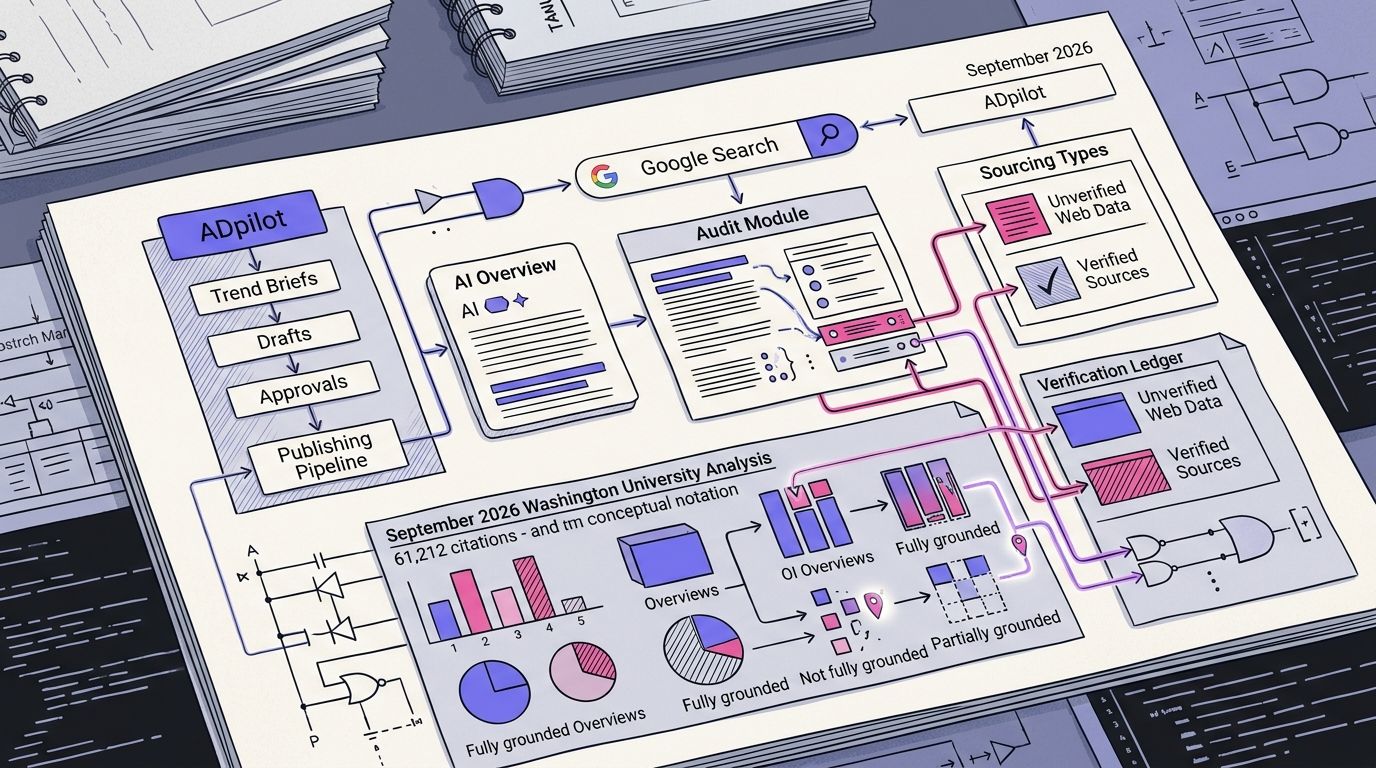
Google AI Overview citations are auditable pointers, not accuracy guarantees: a September 2026 Washington University analysis of 61,212 citations found only 41.9% of Overviews fully grounded. Verified sourcing earns citation consideration by making claims checkable, not by triggering any confirmed Google reward.
What's verified here: the Washington University figures, Google's own admission that AI search reporting in Search Console is thin and ADpilot's prices and gates. What's not verified: that Google runs an official programme rewarding "verified sourcing". We say so in plain language below rather than selling you a rule that doesn't exist.
Table of Contents
- What Google Confirmed About the AI Overview Pilot and What It Did Not
- The Grounding Gap Behind Google AI Overview Citations
- The Source-Before-Sentence Method
- Week One Day 1: Sign-Up, Brand Setup and What It Costs
- Week One Day 2: Your First Trend Brief
- Week One Days 3 and 4: First Drafts Through 8 Quality Gates
- Week One Day 5: Your First Approval
- Week One Days 6 and 7: First Publish to 17 Platforms
- How to Measure Google AI Overview Citations After Week One
- Verified Sourcing vs Volume: How the Tools Compare
- What the Machine Does Not Do
- Frequently Asked Questions
ADpilot costs 79 EUR a month after a 7-day free trial: (1) sign up, (2) set your brand, (3) approve the first drafts, (4) publish. Takes 7 days.
What Google Confirmed About the AI Overview Pilot and What It Did Not
AI Overview citation: a linked source panel attached to a Google AI-generated answer, intended to let a user inspect the webpages used to support that answer.
Let's start with the uncomfortable part. Industry reporting through September 2026 describes Google testing payments to publishers for contributions to AI answers, alongside richer source panels and Preferred Sources. The roundups at Position Digital and Prompt Marketing track those tests week by week.
What none of that evidence shows is an official Google rule that pays you, ranks you higher or cites you more often because your page carries citations. The phrase "pilot rewards verified sourcing" is a description of observed behaviour, not a documented Google programme name.
We'd rather tell you that on day one than sell you a shortcut that evaporates in November.
Here's the part that does hold up. The reported Washington University study, published September 2026, analysed 55,393 Google searches run between March 13 and April 21, 2026. AI Overviews appeared on 13.7% of all queries and on close to 65% of question-form queries against 9.5% for everything else (WashU research summary, 2026).
That gap is the whole opportunity. If question-shaped queries trigger Overviews at nearly seven times the rate of other queries, then the question is the unit of work. Not the keyword. Not the word count.
The same study found that cited domains carried higher average credibility scores than the traditional first-page results for the same searches. Credibility, measured at the domain level, correlated with being used as a source. That's as close to a mechanism as the public evidence gets and it's enough to build a week around. We went deeper on the reporting side in our AI Overviews visibility walkthrough.
The Grounding Gap Behind Google AI Overview Citations
Grounding: the condition where every verifiable claim in an AI Overview is supported by text on the pages it cites.
Most people believe a citation proves the claim above it. The data shows otherwise. Researchers assessed 98,020 verifiable claims against cited webpages and found 7% absent from the collected cited text and 4% directly contradicting the source, leaving only 41.9% of Overviews fully grounded (Washington University, 2026).
Eleven percent of claims either weren't there or said the opposite. That's the grounding gap.
Do not chase raw citation counts. One study reported an average of five cited sources per query (Surfer, 2026) and adding a sixth link to your page does nothing. Grounding depends on whether a specific sentence on your page supports a specific claim in the answer. A machine extracting text needs a line it can lift.
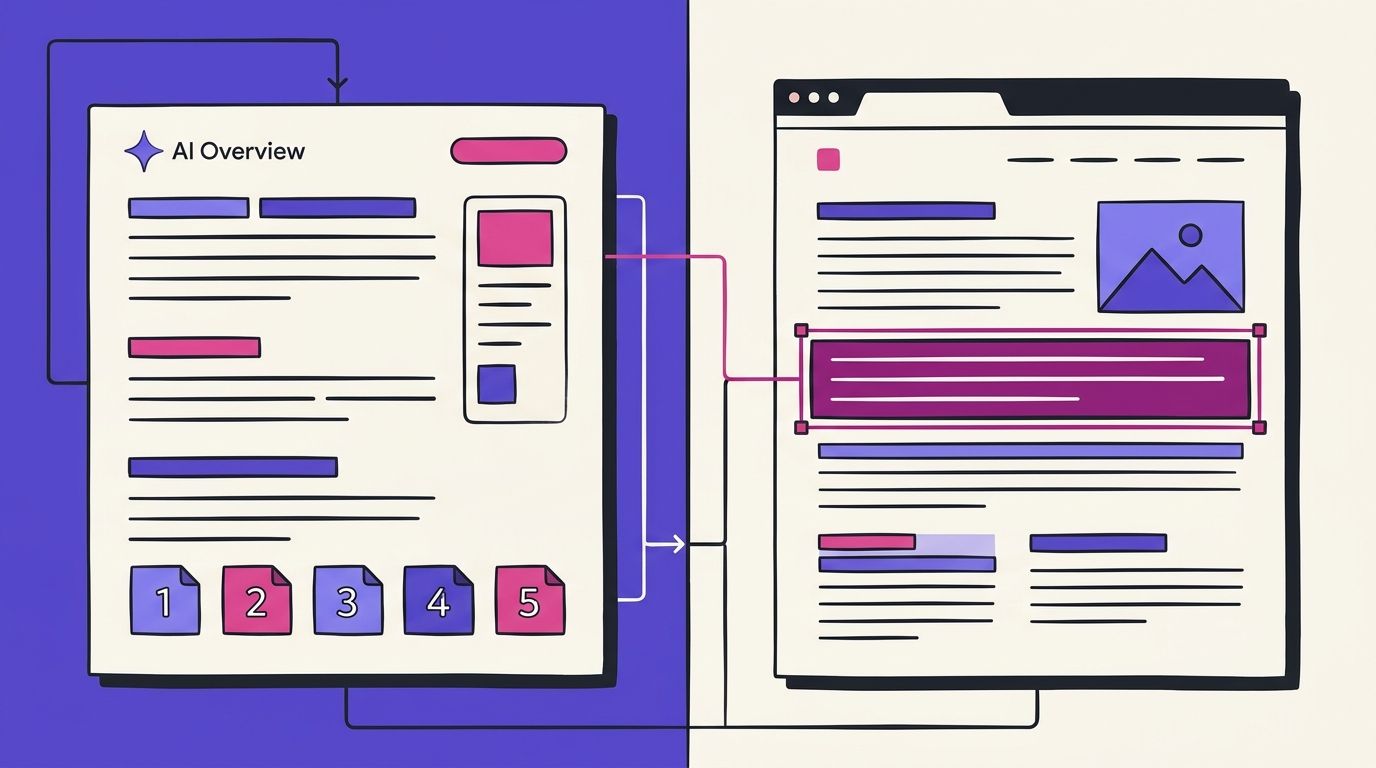
Second misconception worth killing: that Overviews only cite first-page results. The same study found 29.8% of cited domains did not appear in the accompanying first-page results. Industry estimates on this clash badly, with reported figures of 17% and roughly 76% for citations drawn from organic top-10 pages. Treat that range as unsettled, not as a target.
What survives all three findings is simple. Pages get used when they carry checkable, extractable, credible claims. Pages get skipped when they carry adjectives.
This is why we built the trend agent to HTTP-verify a source before any draft is allowed to reference it. If the URL doesn't resolve and return the text, the claim doesn't enter the draft. We covered the same logic in our breakdown of fact-verified content in GSC AI Mode.
The Source-Before-Sentence Method
The Source-Before-Sentence Method: fetch and verify the source first, bind each claim to a retrieved line of text and refuse to write any sentence that has no fetched line behind it.
Three steps and the order is the point.
Step 1: Fetch before you believe. Every source the trend agent proposes gets an HTTP request. A headline in a newsletter isn't a source. A URL that returns the sentence is. Dead links, paywalled stubs and summaries of summaries get dropped at this stage.
Step 2: Bind the claim to the line. Each statistic in a draft carries the source it came from, the figure and the year marker. "89% of claims clearly or broadly supported (Washington University, 2026)" is bindable. "Studies show most AI answers are accurate" is not and it's exactly the kind of sentence an extraction model has no use for.
Step 3: Score before publish. The draft runs through a 5-axis truth score and an AI-tell filter before a human ever sees it. Unbound claims get flagged back to the agent, not to you.
Why this order matters for Google AI Overview citations: the answer engine is doing the same job in reverse. It reads your page looking for a line that supports a claim it wants to make. If your page states the figure, the source and the date in one sentence, you've done the extraction work for it.
Most content tools write the sentence first and look for a supporting link afterwards. That's backwards and it's how you end up contributing to the 4% of claims that contradict their own citations.
You don't have to run this by hand. It's the loop. What follows is what week one looks like when the loop runs for you.
Week One Day 1: Sign-Up, Brand Setup and What It Costs
Sign-up is self-serve at adpilot.ee. No sales call, no demo request, no queue. Growth is 79 EUR a month with a 7-day free trial. Scale is 99 EUR a month and adds SEO OS. Billing runs through Stripe.
Your job on day one is brand setup and it's the only part the machine can't do alone.
You give it three things. What you sell, who you sell to and a few samples of how you write. The voice model learns from the samples. If you have no samples, you write two paragraphs the way you'd write them in an email and that becomes the baseline.
You also set your market and language. Content is written natively in 22 languages, which means drafted in the language, not translated into it. For a US or UK brand that's one setting you'll never touch again. For anyone selling across Europe it's the difference between one content budget and five.
Then you set the gates you care about. Compliance rules cover 9 regulated verticals. If you're in finance, health or gambling, you turn the relevant pack on and every draft from then on is checked against it before it reaches you.
What it costs you in time on day one is one sitting. What it costs in money during week one is nothing, because the trial runs 7 days.
The honest limit: a voice model trained on two paragraphs is thinner than one trained on ten. If you have old newsletters, paste them. We've watched the difference and more samples produce drafts that need fewer edits on day five.
By the end of day one you have a brand profile, a language, a market and a gate configuration. Nothing is published. Nothing can be published without you.
Week One Day 2: Your First Trend Brief
Trend brief: a dated summary of what moved in your market, with every underlying source HTTP-verified before it is passed to the drafting stage.
Day two is when the machine starts working and you mostly read.
The trend agent watches your market and returns a brief. Each item carries the claim, the source URL and the fetch status. Items whose sources failed verification don't appear. That sounds small. It's the single biggest difference between a brief you can publish from and a brief that quietly invents a statistic.
Consider what the evidence says about why this matters. The Washington University analysis found cited domains scored higher on average credibility than the standard first-page results for the same queries. Your brief is where domain credibility either gets built or gets spent.
Your job on day two is to cross off the items that don't fit. Maybe three of eight are wrong for your brand. You say so and the agent learns the boundary.
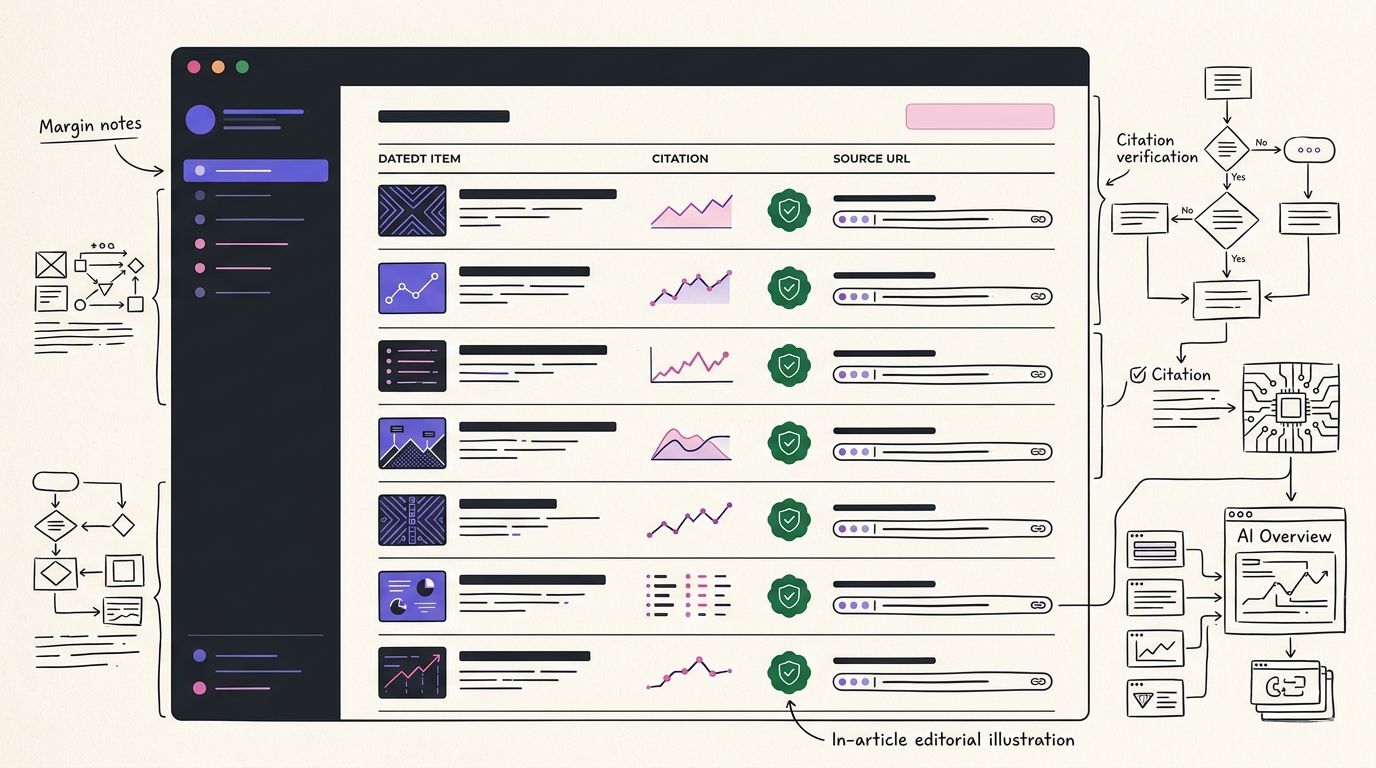
What you get out of the brief is the angle, not just the topic. Question-form queries reportedly produced Overviews at nearly 65% versus 9.5% for other searches (Washington University, 2026). So the brief is shaped toward the questions your market is actually asking this week, which is where Overview exposure concentrates.
If you've been hedging search volatility across channels, the brief doubles as a feed for social. We wrote about that spread in hedging search volatility with 17 platforms.
Time cost on day two: reading, roughly a coffee. The machine did the watching.
Week One Days 3 and 4: First Drafts Through 8 Quality Gates
Quality gate: an automated pass a draft must clear before a human sees it, covering humanity score, truth, AI tells and vertical compliance.
Drafts arrive on day three. Long-form SEO articles and platform-native social posts, written in your learned voice.
Before anything reaches your approval queue it runs 8 gates. The humanity threshold is 70+. The truth score is 5-axis. The AI-tell filter strips the vocabulary that makes a page read like a template. Compliance runs against whichever of the 9 regulated verticals you switched on.
Drafts that fail get redrafted automatically. You never see the failures, which is deliberate, because reviewing bad drafts is the exact job we're taking off your plate.
what the gates do for Google AI Overview citations specifically. An answer engine extracting your page needs atomic, bound, dated claims. The truth score rejects unbound figures. The AI-tell filter removes the padding that buries them. What's left is a page with a higher density of extractable sentences per scroll.
That's the mechanism. There's no magic in it and we won't tell you a gate guarantees a citation. Research reports no confirmed Google rule awarding rankings or inclusion for sourcing practices and anyone claiming otherwise is guessing.
| Stage | What you do | What the machine does | Your time | Cost in week one |
|---|---|---|---|---|
| Day 1: sign-up and brand setup | Paste writing samples, set market, language, compliance pack | Learns voice, builds brand profile across 22 languages | One sitting | 0 EUR (7-day trial) |
| Day 2: first trend brief | Cross off off-brand items | Watches market, HTTP-verifies every source before trusting it | Minutes | 0 EUR |
| Days 3 to 4: first drafts | Nothing | Drafts long-form and social, runs 8 gates, 70+ humanity, 5-axis truth | None | 0 EUR |
| Day 5: first approval | Read and approve or edit | Holds everything until you click | Per-piece review | 0 EUR |
| Days 6 to 7: first publish | Nothing | Publishes to 17 platforms plus your blog | None | 0 EUR |
| Week 2 onward | Approve | Tracks rankings via Search Console, redrafts what slips | Per-piece review | 79 EUR a month (Growth) |
Best for: founders and small teams who need published, sourced content every week without hiring a writer or a tool stack.
Week One Day 5: Your First Approval
Day five is the only hard gate and it's a human one.
Nothing publishes without your approval. Not a post, not an article, not a comment. The approval workflow exists because we don't believe a 70+ humanity score replaces a founder reading their own claims.
What you're checking is narrow. Is the claim true for your business? Is the source the one you'd stand behind? Does the voice sound like you on a good day?
You'll edit some. First week, most people edit the opening line and little else, because the voice model is tuned on your samples and the gates already stripped the tells. Your edits feed back. The machine learns what you changed and why, so week two's drafts land closer.
This is where most autonomous marketing tools lose people. They publish on a schedule and hand you a dashboard afterwards. We built the other way, because the cost of one wrong claim in a regulated vertical is larger than the cost of one approval click.
There's a second reason approval sits here. The grounding evidence shows 4% of assessed AI Overview claims contradicted their cited source (Washington University, 2026). Machines misread sources. Ours fetches and binds, which cuts the failure rate and your eyes close the rest.
If you run several brands, the approval queue is per brand, which is how agencies keep ten voices separate without ten logins' worth of context switching. We've written about tool selection for that case in what makes an AI SEO tool worth paying for.
What day five costs: one review session. What it prevents: the sentence you'd have had to retract.
Week One Days 6 and 7: First Publish to 17 Platforms
Approved pieces publish to 17 platforms plus your own blog. Platform-native, which means the LinkedIn version isn't the blog intro with hashtags bolted on.
Your blog post carries the sourced claims. The social posts carry the hook and the link. That split matters because Overview exposure and social reach reward different shapes of the same idea.
By day seven you have published work with verified sources attached, in your voice, that you read and approved. That's the end of the free trial. If you stop there, you stop with assets you own.
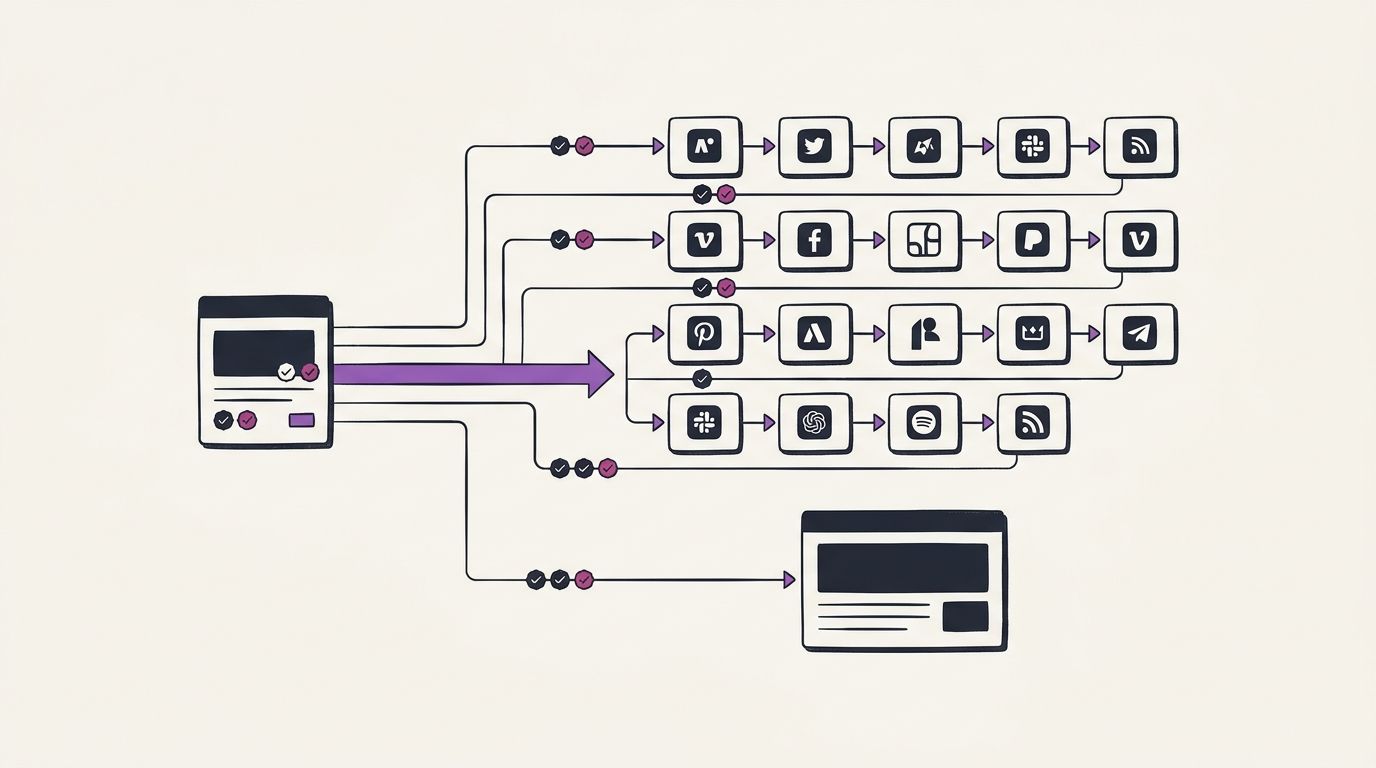
One honest note on distribution. Publishing wide doesn't make Google cite you. Credibility at domain level and extractable claims at sentence level are what the evidence points to. Distribution builds the signals around the page. It doesn't substitute for the page.
Scheduling is yours. Daily, three times a week, weekly. We'd suggest starting at whatever you can approve without dreading it, because an approval queue you avoid is a content engine that stalls on day twelve.
From week two the loop runs: brief, draft, gate, approve, publish, measure, redraft. The redraft trigger is ranking movement pulled from Google Search Console, which brings us to the measurement problem nobody has solved.
How to Measure Google AI Overview Citations After Week One
Here's the part the rest of the industry is quiet about. You cannot cleanly measure Google AI Overview citations in Search Console today.
Google has acknowledged that its Search Console reporting for AI search is inadequate, as covered by Search Engine Journal. AI surfaces are grouped and impression-weighted in ways that hide which answer used your page.
So what do you actually track in week two?
Impressions on question-form queries. Given that Overviews reportedly fire on close to 65% of question-shaped queries versus 9.5% elsewhere (Washington University, 2026), a rise in impressions against question queries with flat clicks is a reasonable, hedged signal that you're appearing inside an answer panel.
Position stability on the pages carrying your bound claims. Since 29.8% of cited domains didn't appear in the accompanying first-page results, position alone won't tell you whether you were cited. It tells you whether the page is still healthy.
Manual spot checks. Run your top ten questions, read the source panels, note the domains. Unglamorous and currently the only direct evidence available.
ADpilot pulls GSC data on the pages it published and redrafts what slips. We don't report a citation count, because the data to support one honestly doesn't exist in the current reporting. We go through what the report does and doesn't expose in our AI Overviews Search Console guide and in the companion piece on what the generative AI report hides.
Anyone selling you a guaranteed citation count in October 2026 is selling you a number they cannot source.
Verified Sourcing vs Volume: How the Tools Compare
Most content tools optimise for output. Ours optimises for what survives a fact check, because an unsourced page is a page an answer engine has no reason to lift from.
| Capability | ADpilot | Typical AI writer (Jasper-style) | Typical scheduler (Buffer-style) | Typical SEO suite (Surfer-style) |
|---|---|---|---|---|
| Source verified by HTTP fetch before drafting | Yes, on every trend source | No, model-recalled links | Not applicable | No |
| Automated quality gates before human review | 8 gates, 70+ humanity, 5-axis truth | Usually none | None | Score-based, not truth-based |
| Regulated-vertical compliance checks | 9 verticals | No | No | No |
| Human approval required before publish | Yes, every piece | Optional | Yes, manual | Not applicable |
| Native languages | 22 | Translation-based | Not applicable | Limited |
| Publishing destinations | 17 platforms plus your blog | Export only | Social only | Export only |
| Search Console feedback into redrafts | Yes | No | No | Partial |
| Entry price | 79 EUR per month, 7 days free | Varies by seat | Varies by seat | Varies by seat |
| Best for | Founders and small teams needing sourced content every week | Fast first drafts you edit yourself | Scheduling an existing content supply | Optimising pages you already wrote |
The honest reading of that table: a writer tool is faster at producing a paragraph. A scheduler is better if you already have a content supply and just need timing. We're built for the case where there is no content team at all and the sourcing has to be right.
What the Machine Does Not Do
Saying what it doesn't do is part of the deal.
It doesn't guarantee Google AI Overview citations. No tool can and the public evidence establishes no official Google rule awarding inclusion for sourcing practice.
It doesn't publish without you. There's no autopilot mode that skips approval, by design.
It doesn't invent proof. We publish no customer counts, revenue figures or testimonials in our own content, because we don't have verified ones to publish and inventing them would fail the same truth gate we run drafts through.
It doesn't replace a specialist in a hard vertical. The compliance gates for 9 regulated verticals catch policy violations. They don't replace your lawyer on a medical claim.
It doesn't fix a product nobody wants. Content distributes an offer. It doesn't create demand that isn't there.
And it doesn't give you a citation dashboard, because Google's own reporting can't support one honestly yet.
What it does: watches your market with verified sources, drafts in your voice, gates every piece, waits for you, publishes to 17 platforms, tracks rankings, redrafts what slips. For 79 EUR a month on Growth, with the first 7 days free.
Frequently Asked Questions
Does Google pay publishers for AI Overview contributions?
Industry reporting through September 2026 describes Google testing payments to publishers for contributions to AI answers. No official Google documentation confirming a live, general programme appeared in the sources we checked, so treat it as a reported test rather than a revenue line you can plan around.
Do Google AI Overview citations only come from top-10 results?
No. The Washington University analysis found 29.8% of cited domains did not appear in the accompanying first-page results. Published industry estimates for how many Google AI Overview citations come from organic top-10 pages conflict sharply, ranging from 17% to roughly 76%, so the question is not settled.
How accurate are AI Overviews when they cite sources?
Of 98,020 verifiable claims assessed, 89% were clearly or broadly supported, 7% were absent from the cited text and 4% contradicted the source (Washington University, 2026). Only 41.9% of Overviews were fully grounded, meaning every claim was supported.
Can I track Google AI Overview citations in Search Console?
Not directly. Google has acknowledged its Search Console reporting for AI search is inadequate and the available reports group AI surfaces with impression-weighted data. Practical proxies are question-query impressions, position stability on sourced pages and manual spot checks of source panels.
What does week one with ADpilot actually cost?
Nothing. Growth runs 79 EUR a month with a 7-day free trial, so your entire first week, from brand setup through first publish, is covered. Scale is 99 EUR a month and adds SEO OS. Billing is through Stripe, self-serve, no sales call.
How much of my time does the first week take?
One setup sitting on day one, a short read of the trend brief on day two and one approval session on day five. Drafting, gating and publishing run without you. The approval step is the only part that stays on your calendar permanently.
Does ADpilot publish without my approval?
No. Every piece waits in your approval queue until you act on it. The 8 quality gates run first so you're reviewing drafts that already cleared the 70+ humanity threshold, the 5-axis truth score, the AI-tell filter and your chosen compliance pack.
Which languages and platforms does it cover?
Content is written natively in 22 languages, not machine-translated after the fact and publishes to 17 platforms plus your own blog. You pick the market and language during day-one brand setup and can change it later.
Where This Leaves You
The evidence doesn't support a Google rule that rewards verified sourcing. It supports something narrower and more useful: cited domains scored higher on credibility than first-page results, only 41.9% of Overviews were fully grounded and question-form queries triggered Overviews at nearly 65%. Pages built from fetched sources and bound, dated claims are the ones an answer engine can actually use, which is the only lever you control in the race for Google AI Overview citations.
Week one is the cheapest way to find out whether that loop works on your brand: setup on day one, brief on day two, drafts by day three, your approval on day five, published work by day seven.
Start your 7-day free trial at adpilot.ee/register
More from the Journal
Want a machine that writes like this for your brand?
Sign up