
How do you get cited by ChatGPT?
To be cited by ChatGPT, your pages first have to be reachable: OpenAI says sites that block its OAI-SearchBot crawler will not be shown in ChatGPT search answers. After that, a page gets cited when it answers the question better than the alternatives: a direct answer near the top, specific facts with sources, and a clear statement of who you are.
By the ADpilot team, ADpilot OÜ, Tallinn. Last updated ; sources checked the same day.
How ChatGPT picks what to cite
When ChatGPT searches the web, it sends one or more queries to search sources, reads a handful of the pages that come back, writes an answer and links the pages it relied on. OpenAI describes ChatGPT search as leveraging "third-party search providers, as well as content provided directly by our partners". So a citation needs three things in a row: ChatGPT must be allowed to fetch your page, your page must turn up for the query it runs, and your page must be the clearest source for the sentence it writes.
You cannot pay for a citation and there is no submission form. You can make each of the three steps more likely. To see where you stand before and after, track your AI visibility on the questions your buyers actually ask.
Step 1: let OpenAI's search crawler in
OpenAI runs separate crawlers for separate jobs. The one that matters here is OAI-SearchBot. OpenAI's documentation says: "Sites that are opted out of OAI-SearchBot will not be shown in ChatGPT search answers, though can still appear as navigational links." Its publisher FAQ repeats it: to be included in summaries and snippets, "make sure you aren't blocking OAI-SearchBot".
- Check robots.txt for a rule that blocks OAI-SearchBot, or blocks every bot.
- Check your CDN or firewall. Bot protection that blocks unknown crawlers can block OAI-SearchBot even when robots.txt allows it. OpenAI publishes its IP ranges so you can allow them.
- You can block GPTBot, which collects training data, and still allow OAI-SearchBot. They are independent.
- Changes to robots.txt take about 24 hours to be picked up, per OpenAI.
Step 2: be findable for the question
ChatGPT can only cite pages its search step finds. That means the ordinary work of search still decides most of it: the page must be indexed, must target the question in its title and headings, and must be the kind of page that ranks for it. OpenAI does not name its search providers, so do not optimise for one engine. Make sure you are indexed in both Google and Bing, submit your sitemap to both, and use IndexNow if your site supports it so new pages are found in hours, not weeks.
Bing Webmaster Tools now has an AI Performance report showing how often your pages are cited in Microsoft Copilot and Bing's AI answers. It does not cover ChatGPT, but it is the only first-party citation report available today and a useful early signal.
Step 3: be the clearest source
Once your page is among the candidates, the writing decides. The GEO research by Aggarwal et al. found that pages with cited sources, quotations and statistics were used far more in AI answers, by up to 40% on their measure, while keyword stuffing did not help. In practice:
- Answer in the first two sentences. Then explain. A page that starts with background loses to one that starts with the answer.
- One page, one question. A page about "everything on cold brew" is a weaker source for "how long does cold brew last" than a page about exactly that.
- Specific facts with sources. Prices, numbers, dates and named studies, linked. Vague claims give the model nothing to quote.
- Say who you are. Your company name, location and what you do, worded the same way on every page and profile, so the model can attach the fact to the right business.
- Keep it current. Show a visible "updated" date and update the facts, not just the date.
Step 4: be mentioned elsewhere
For questions like "what is the best tool for X", assistants lean on comparison articles, directories, reviews and discussions more than on a vendor's own page. Being listed honestly in the places your category is discussed often matters more than anything on your own site. Never fake it: invented reviews and paid "best of" placements are what search engines and AI engines are built to discount.
How to know it is working
| Signal | Where to see it |
|---|---|
| Visits from ChatGPT | Your analytics: ChatGPT adds utm_source=chatgpt.com to the links it sends. |
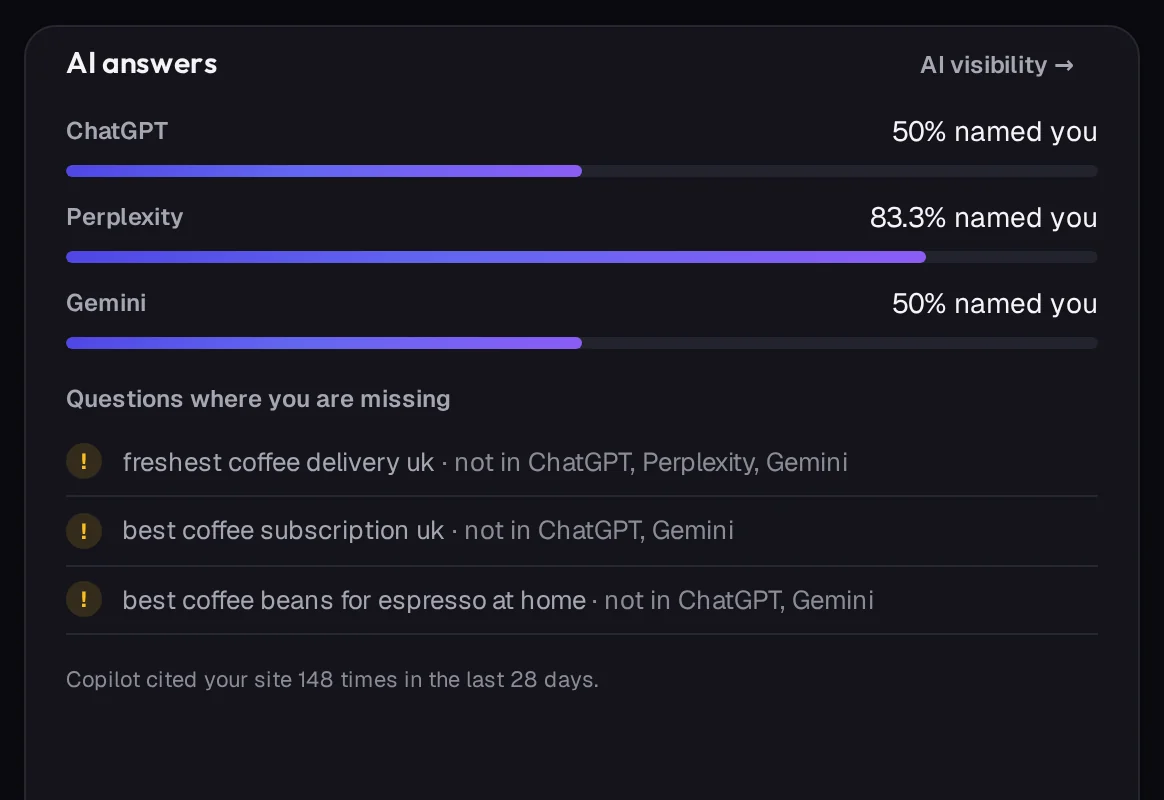
| Whether ChatGPT names you | Ask your list of buyer questions every week and record the answers. Single answers vary; the trend is what counts. |
| Copilot and Bing AI citations | Bing Webmaster Tools, AI Performance. |
| Search visibility underneath | Google Search Console and Bing Webmaster Tools. |
None of this guarantees a citation, and anyone who promises one is guessing. Being reachable, findable and the clearest answer is what you control.
How ADpilot helps
AI visibility tracking in ADpilot shows this for your own brand. See how AI visibility tracking works.
Real ADpilot screen, demo brand