
How should you review AI content before publishing?
Review AI content the way an editor reviews a freelancer: check every fact, number and claim against a source, check that it sounds like you and says something useful, then have a named person approve it and keep a record. Google judges content by its quality, not by whether AI wrote it, and EU AI Act Article 50(4) exempts AI-generated public-interest text from disclosure only when it went through human review and someone holds editorial responsibility.
By the ADpilot team, ADpilot OÜ, Tallinn. Last updated ; sources checked the same day.
Why review matters more than how it was written
Google has said since February 2023 that it rewards quality "rather than how content is produced", and that appropriate use of AI is not against its guidelines. What it acts against is scale without value: its spam policy defines scaled content abuse as "many pages generated for the primary purpose of manipulating search rankings and not helping users", "no matter how it's created", and its guidance on AI content names generating many pages without adding value as an example.
The law is moving the same way. EU AI Act Article 50(4), which applies from 2 August 2026, requires deployers to disclose that text was AI-generated when it is published to inform the public on matters of public interest, unless the content "has undergone a process of human review or editorial control" and a person or company "holds editorial responsibility". Review is not only good practice; it is what the exemption asks for.
A review step is only useful if it is consistent. Here is a routine that works for a small team, followed by how to keep a record. ADpilot builds it in: every draft waits in an approval queue by default, and every approval is logged.
The five checks
- Facts. Every number, price, date, name and quotation is checked against a source you would be willing to link. AI writers produce fluent sentences around wrong numbers; this is the check that saves you. If you cannot verify a claim, cut it.
- Claims you are not allowed to make. Health, finance, legal and regulated products have words that can get a post removed or a business fined: "cure", "guaranteed returns", "best in town" without proof. Keep a list per brand and read for it.
- Voice. Read it aloud. Would you say this to a customer? Remove filler openings, stacked adjectives and the phrases that make readers think "AI wrote this".
- Usefulness. Does it tell the reader something they did not know, or show something only you can show: your prices, your process, your photos, your numbers? If not, it is the kind of page Google's scaled content policy describes.
- Fit for the platform. Length, hashtags, image text, links and the call to action suit where it is going. A LinkedIn post pasted into Instagram reads wrong.
Who approves
Name one person per brand who approves, and one backup. For agencies, decide which posts the client must approve and which the agency approves alone; common rules are "everything for the first month" and "anything that mentions a price, an offer or a person". Give clients a way to approve that does not need a login, or approvals will stall in email threads.
If a post is edited after approval, the approval should no longer count. Otherwise the version that goes out is not the version anyone signed off.
Keep a record
| Record | Why |
|---|---|
| Who approved, and when | Shows the human review and editorial responsibility Article 50(4) refers to. |
| Whether a person edited it | Separates reviewed-and-changed from approved-as-is. |
| The sources behind factual claims | Lets anyone check a claim later without redoing the research. |
| What was published, where, and when | Lets you find and correct a post if a fact turns out to be wrong. |
For images, the obligation sits elsewhere: Article 50(2) requires providers of AI systems that generate images, audio, video or text to mark their output in a machine-readable way as artificially generated. Choose tools that do this. Google's guidance also points to IPTC metadata for AI-generated images in shopping listings.
Should you label AI content anyway?
Where the law requires it, yes. Elsewhere it is a judgement call. A short, plain label such as "Created with AI assistance and reviewed by our team" costs little and is honest. What matters more to readers, search engines and regulators is the review itself: correct facts, a real point of view, and a person who stands behind what was published.
This page explains general rules, not legal advice for your situation. If you publish in a regulated field, check with someone who knows your market.
How ADpilot helps
Approval workflow in ADpilot shows this for your own brand. See how Approval workflow works.
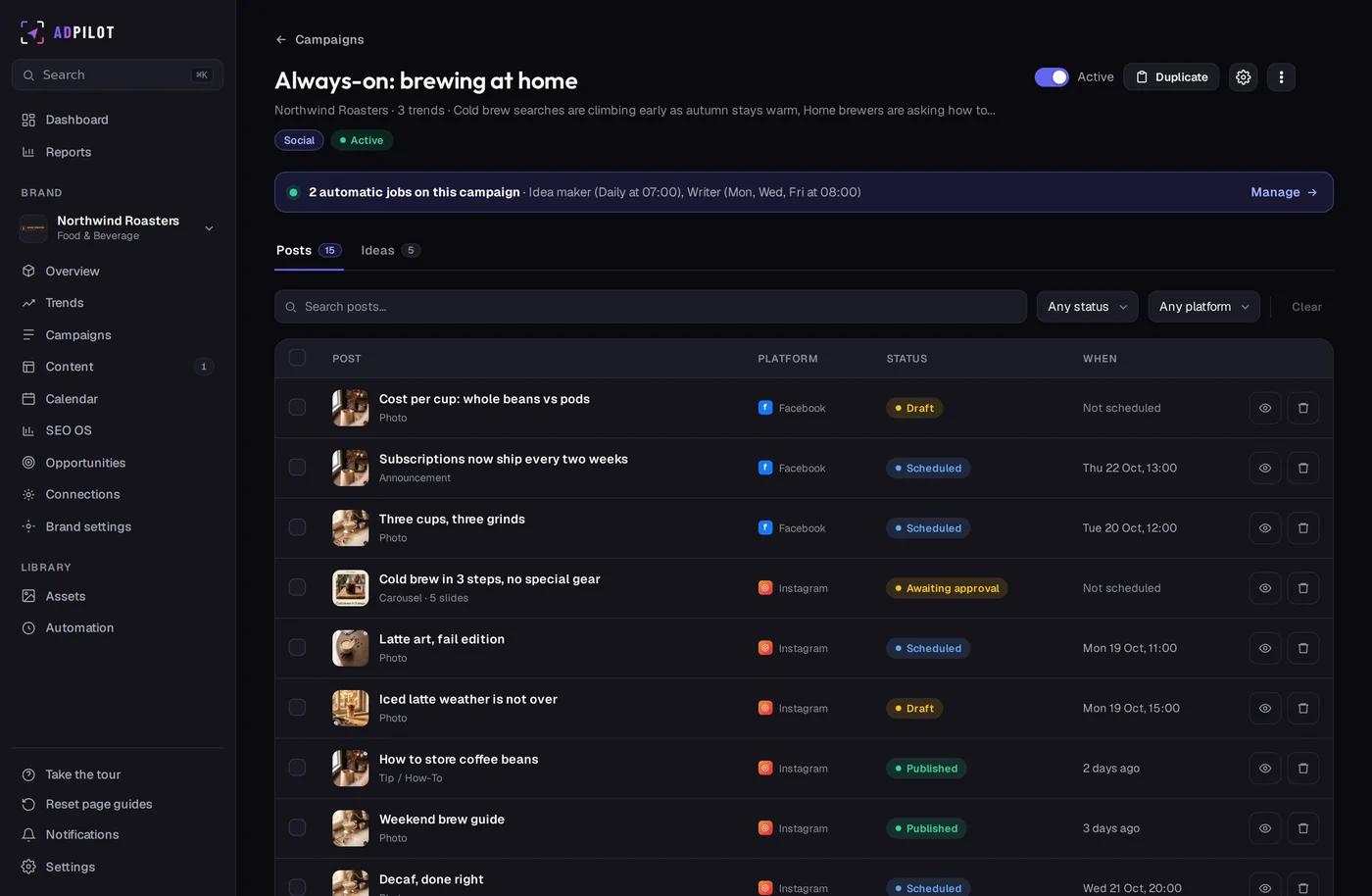
Real ADpilot screen, demo brand