
What is llms.txt, and does it matter?
llms.txt is a proposed Markdown file at the root of a website (/llms.txt) that gives large language models a short summary of the site and a list of links to its most useful pages. It was proposed by Jeremy Howard in September 2024. It is cheap to publish and useful for AI coding and documentation tools, but Google says Google Search does not use it, so it is not a ranking or AI Overviews lever.
By the ADpilot team, ADpilot OÜ, Tallinn. Last updated ; sources checked the same day.
What the file is
llms.txt is a plain Markdown file served at the root of a website, for example example.com/llms.txt. It was proposed by Jeremy Howard on 3 September 2024 at llmstxt.org as a way to give language models "brief background information, guidance, and links to detailed markdown files" about a site, because a model reading a full web page wastes most of its limited context on navigation, scripts and layout.
Think of it as a short, hand-written map: what this site is, and which pages matter. It does not replace robots.txt (which says what may be crawled) or sitemap.xml (which lists every URL). It is a curated summary for a reader that has little room.
What goes in it
The proposal defines a small structure, in this order:
- An H1 with the name of the site or project. This is the only required part.
- A blockquote with a one or two sentence summary containing the key facts.
- Optional paragraphs or lists with more detail, but no further headings.
- Sections under H2 headings, each a list of links written as
[name](url), optionally followed by a colon and a short note. - By convention, a section called "Optional" for links an agent can skip when it is short on space.
A small business version might be ten lines: name, a one-sentence description with location and prices, then links to pricing, the main service pages and the contact page. ADpilot publishes its own llms.txt, generated from the same facts as the pricing page so the two cannot disagree.
Who actually reads it
This is where expectations need adjusting. Google's guide to its generative AI features, updated in July 2026, says directly that you do not need to create "new machine readable files, AI text files, markup, or Markdown" to appear in Google Search or its AI features, "as Google Search itself doesn't use them", and lists llms.txt by name among tactics you can ignore for Google.
No major AI search engine has published a statement that it uses llms.txt to choose what to cite. Where the file clearly helps is with tools that read documentation on demand: coding assistants and agents that are pointed at a site and need its structure fast. That is why developer documentation sites adopted it first; both Anthropic and OpenAI publish one for their developer docs.
So does it matter?
| Question | Answer |
|---|---|
| Will it improve Google rankings or AI Overviews? | No. Google says Search does not use it. |
| Will it get you cited in ChatGPT or Perplexity? | There is no public evidence that it does. Their crawlers read your normal pages. |
| Is it worth an hour? | Usually yes. It is cheap, it forces you to write down your key facts once, and agents that do read it get them right. |
| Can it hurt? | Only if it disagrees with your pages. Conflicting prices or descriptions give AI systems a reason to doubt both. |
What moves AI visibility more
If the goal is to be named in AI answers, the work that matters sits in your normal pages and your reputation elsewhere:
- Crawler access. Allow OAI-SearchBot, PerplexityBot, Bingbot and Googlebot in robots.txt and at your firewall.
- One set of facts. The same company description, prices and numbers on every page, profile and directory.
- Answer-first pages. A direct answer in the first two sentences of the page that targets each question.
- Measurement. Track which searches you show up for and which AI answers name you, so you can see whether anything you change works. SEO OS puts Google, Bing and AI answer data in one place for exactly this.
Publish an llms.txt if you like, keep it short and accurate, generate it from the same source as your pages if you can, and then spend the rest of the time on the list above.
How ADpilot helps
SEO OS in ADpilot shows this for your own brand. See how SEO OS works.
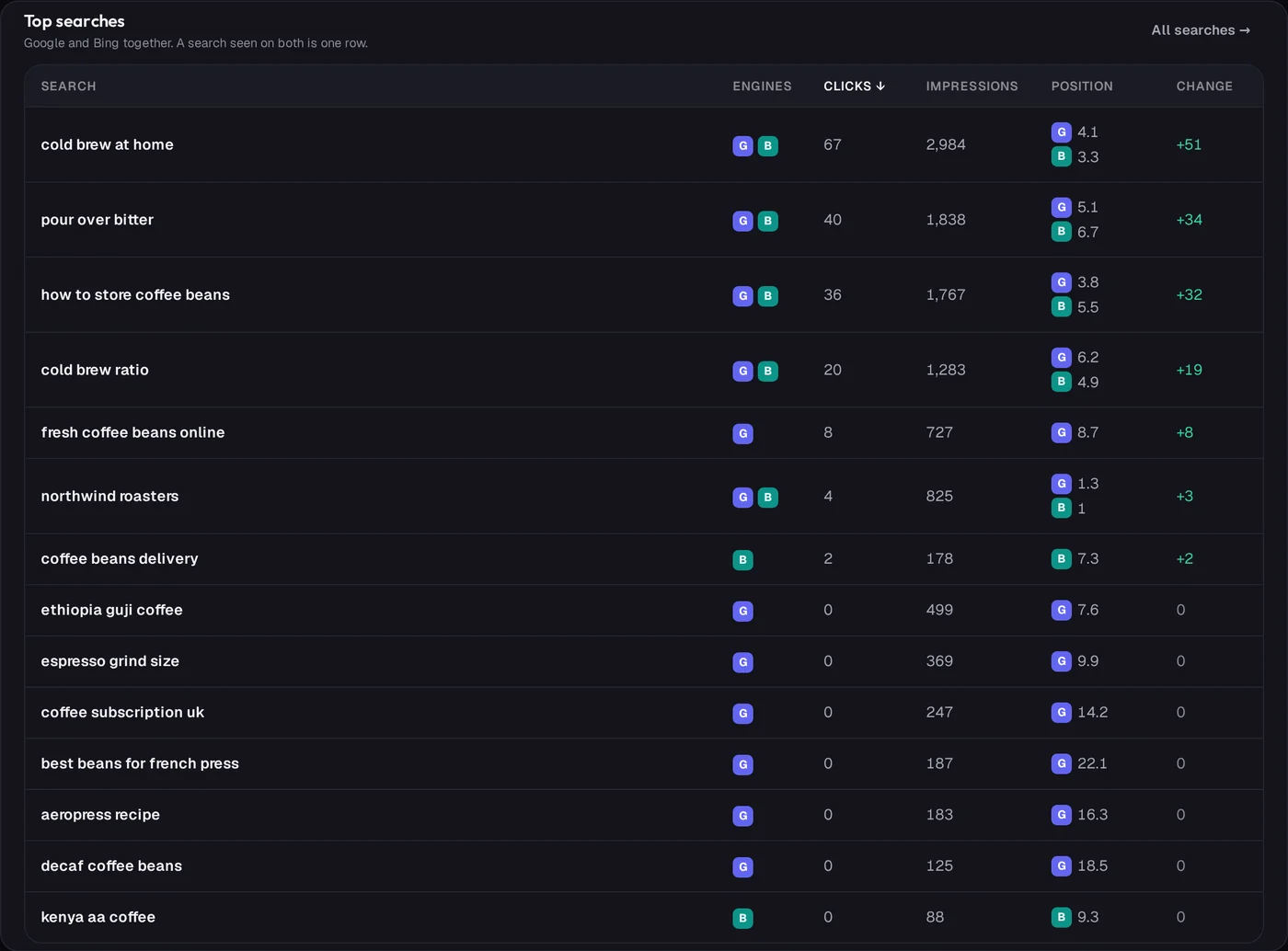
Real ADpilot screen, demo brand