
What is generative engine optimization (GEO)?
Generative engine optimization (GEO) is the practice of shaping content so AI answer engines such as ChatGPT, Perplexity and Google's AI features are more likely to use it and cite it. The term comes from a 2023 research paper that found citing sources, adding quotations and adding statistics raised a page's visibility in AI answers by up to 40%, while keyword stuffing did not help.
By the ADpilot team, ADpilot OÜ, Tallinn. Last updated ; sources checked the same day.
The short definition
Generative engine optimization, usually shortened to GEO, is the work of making your content more likely to appear, be quoted and be linked in answers written by AI systems. Search engine optimization aims for a position in a list of ten links. GEO aims for a sentence inside an answer, ideally with your page as the cited source.
The engines in question are the ones that write a reply instead of showing a list: ChatGPT with search, Perplexity, Google's AI Overviews and AI Mode, Gemini and Microsoft Copilot. Each one retrieves pages, reads them, and writes a summary with a few citations. GEO is about being one of those few. If you want to see where you stand today, AI visibility tracking asks those engines your buyers' questions every week and records whether you are named.
Where the term comes from
The name comes from a 2023 research paper, "GEO: Generative Engine Optimization" by Aggarwal and colleagues, accepted at the KDD 2024 conference. The authors built a benchmark of search queries (GEO-bench), rewrote source pages with different methods, and measured how much of each AI answer came from each source and how prominently it appeared.
Their headline result: the right changes to a page "can boost visibility by up to 40% in generative engine responses", and the effect differs by subject. What worked and what did not is the useful part:
| Method | What the paper found |
|---|---|
| Cite sources | Among the top methods, 30 to 40% relative improvement on the paper's main visibility measure. |
| Add quotations | Among the top methods; the best single method when tested on Perplexity itself. |
| Add statistics | Among the top methods, with a similar 30 to 40% relative improvement. |
| Improve fluency and readability | A 15 to 30% boost, and the best pairing was fluency plus statistics. |
| Keyword stuffing | Did not perform well, and on Perplexity it did worse than doing nothing. |
One more finding matters for small businesses: the gains were largest for sources that started lower in the search results. In the paper's tests, pages ranked fifth gained far more from citing sources and adding quotations than pages already ranked first. GEO is one of the few places where a smaller site can catch up by being more useful.
How GEO differs from SEO
Most of what makes a page rank also makes it citable: it must be crawlable, indexed, fast and clearly about one thing. The difference is in what the reader is. A person scanning results clicks the most promising title. A model reading five pages picks the sentences that answer the question with the least doubt. So GEO rewards:
- An answer in the first two sentences. If the answer is buried under an introduction, the model quotes someone else.
- Specific, checkable facts. Numbers, dates, prices and named sources give the model something to quote with confidence.
- Clear entities. Say who you are, where you are and what you do in plain words, the same way everywhere. An AI system that is unsure which company you are will leave you out.
- Corroboration elsewhere. Engines prefer facts they can find in more than one place: directories, reviews, press and other people's articles.
What Google says
Google's own documentation is blunt about its AI Overviews and AI Mode: "There are no additional requirements to appear in AI Overviews or AI Mode, nor other special optimizations necessary." The same SEO basics apply, and Google's 2026 guide to its generative AI features says you can ignore tactics such as chunking content for AI or creating AI text files. For Google, GEO is mostly good SEO and good writing. For ChatGPT and Perplexity there is one extra step that is easy to miss: their own crawlers, OAI-SearchBot and PerplexityBot, must be allowed in your robots.txt, or your pages cannot appear in their answers at all.
Where to start
- Check access. Make sure robots.txt and your firewall allow Googlebot, Bingbot, OAI-SearchBot and PerplexityBot.
- Write down the questions. List 10 to 25 questions a buyer would ask an assistant, without your brand name in them.
- Measure a baseline. Ask each engine each question and record whether you are named and cited. Repeat weekly; single answers vary.
- Fix the pages that should win. Put the answer first, add the numbers and sources, and make each page about one question.
- Earn mentions. Get listed and discussed where the engines look: directories, comparison articles and communities, honestly.
GEO is young, the engines change monthly, and nobody can promise a citation. What the research and the engines' own documents agree on is simple: be reachable, answer directly, and back up what you say.
How ADpilot helps
AI visibility tracking in ADpilot shows this for your own brand. See how AI visibility tracking works.
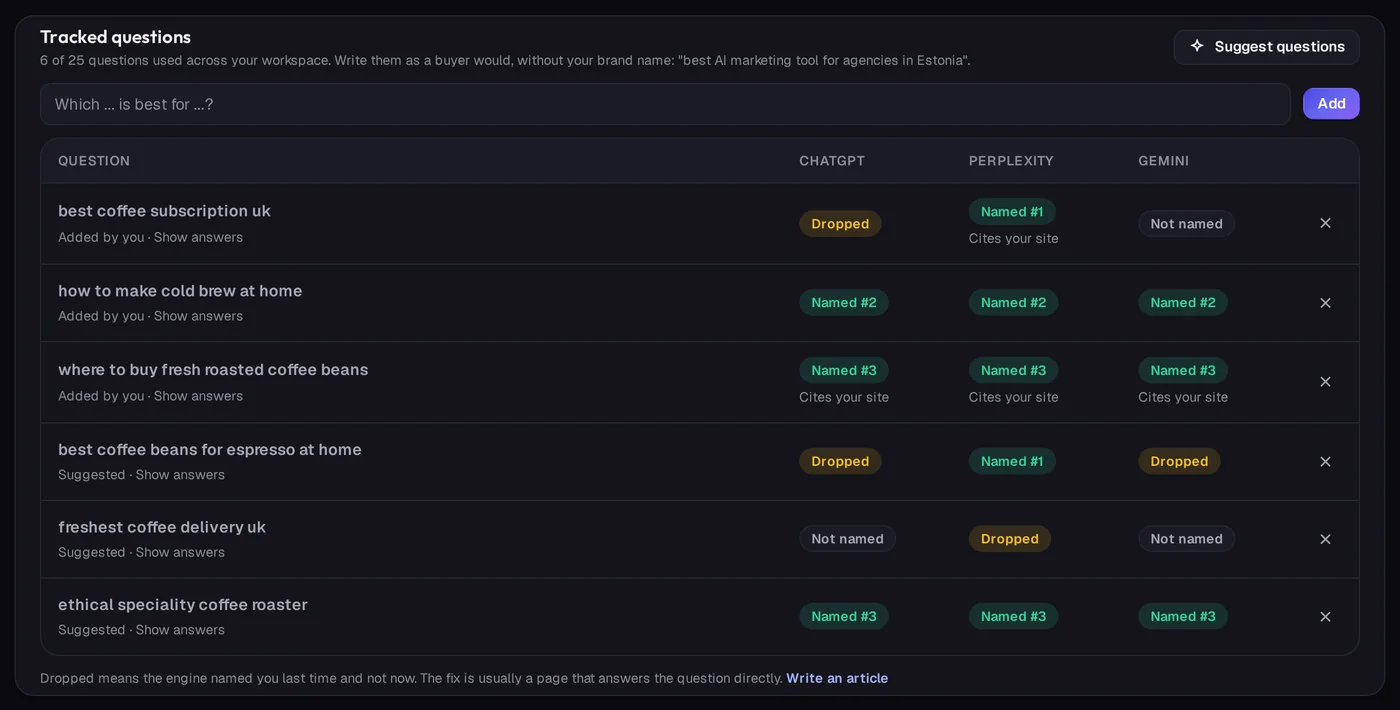
Real ADpilot screen, demo brand
Sources
- Aggarwal et al., "GEO: Generative Engine Optimization", arXiv 2311.09735 (KDD 2024)
- Google Search Central, "AI features and your website"
- Google Search Central, "Google's guide to optimizing for generative AI features on Google Search"
- OpenAI, "Overview of OpenAI crawlers"
- Perplexity, "Perplexity crawlers"