

Answer
What is AI visibility, and how do you measure it?
AI visibility is how often AI assistants such as ChatGPT, Perplexity, Gemini and Copilot name your business, and link to your site, when people ask the questions your customers ask. Because each assistant writes a new answer every time, it is measured as a rate: the same buyer questions, asked of each engine on a schedule, counting mentions, citations and position.
The short definition
AI visibility is how often AI assistants name your business, and link to your site, when people ask them the questions your customers ask. It is the AI answer equivalent of a search ranking, with one difference: there is no single position to look up. Each assistant writes a new answer every time, from whatever pages it finds that moment, so visibility has to be measured as a rate over many questions and many runs.
The assistants that matter for most businesses are ChatGPT, Perplexity, Google's Gemini and AI features in Search, and Microsoft Copilot. Making yourself more likely to appear in their answers is called generative engine optimization; AI visibility is the number that tells you whether that work is paying off.
What to measure
There is no industry standard yet, but four measures cover what a business owner wants to know. They separate being mentioned from being cited, which are not the same thing: an assistant can recommend you by name and link only to a review site.
| Measure | The question it answers | How it is counted |
|---|---|---|
| Mention rate | Do AI answers name us at all? | Answers that name the brand, divided by all answers checked |
| Citation rate | Do they send people to our site? | Answers whose cited sources include one of your domains |
| Position | When we are named, are we first or fifth? | Where the brand sits among the companies the answer names |
| Share of voice | Who gets named instead of us? | Your mentions compared with each competitor's, over the same answers |
Two more are useful once the basics are in place: which domains the assistants cite most often for your questions (often directories, review sites or a competitor's guide, which tells you where to get listed or what to write), and whether the answers describe you positively, neutrally or negatively.
How to measure it yourself
- Write the questions. List 10 to 25 questions a buyer would ask before choosing a business like yours, without your brand name: "best dentist for children in Tartu", "which accounting software works for a one-person company in Estonia". Branded questions only tell you whether the assistant knows you exist.
- Ask every engine, with search on. Answers from a model's memory and answers grounded in a live web search differ. Buyers mostly see the grounded kind, so measure that.
- Record the answer, not just a yes or no. Keep the text, the companies named in order and the cited URLs, with the date. You will want to look back at what changed.
- Repeat on a fixed schedule. Answers vary from run to run because the engines search live. One answer is an anecdote; the same questions every week for a month is a trend.
- Read the misses. For each question where you are not named, open the cited pages. They show what the assistant found convincing.
How ADpilot measures it
This is the method behind AI visibility tracking in ADpilot, described as the code does it:
- Three engines, through their search-grounded APIs. ChatGPT is asked through OpenAI's web search tool, Perplexity through its Sonar model, and Gemini with grounding in Google Search. Each returns an answer and the URLs it cited.
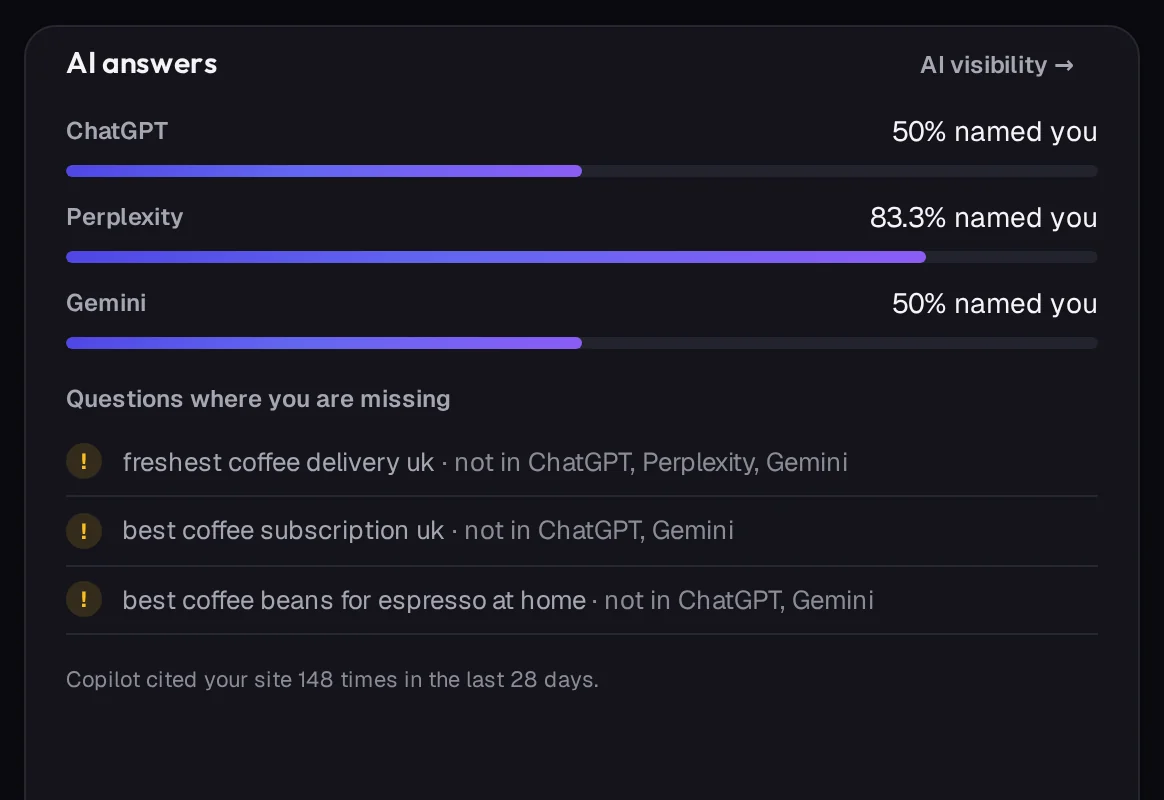
- Weekly, per question. Every tracked question is asked of every engine once a week, and the latest answer per question and engine is what the page shows. You write the questions or take ten suggestions built from your brand profile; the number you can track depends on your plan.
- A strict name match. Your brand counts as mentioned only as a whole word, ignoring case and accents, and a brand name that is also an ordinary word must appear as a proper noun. A citation counts as yours when its host is your site or a subdomain of it, not a look-alike domain.
- Competitors and sentiment. The competitors saved on your brand are detected the same way, which gives share of voice; answers that name you are classified as positive, neutral or negative in one batched call.
One honest limit: the API answers are close to, but not the same as, what a person sees in the ChatGPT or Gemini apps, which add personalisation, location and conversation history. The weekly trend on a fixed set of questions is the reliable part, not any single answer.
Microsoft is the one engine that reports this from its side. Bing Webmaster Tools has an AI Performance report, in public preview since February 2026, that shows how often your pages are cited in Copilot and Bing's AI summaries, which pages, and a sample of the grounding queries behind the citations. ADpilot can import that export next to its own numbers.
What moves the number
- Being reachable. OpenAI says sites that block OAI-SearchBot will not be shown in ChatGPT search answers. Check robots.txt and your firewall for it, PerplexityBot, Bingbot and Googlebot.
- A page per question. If no page on your site answers the question directly, an assistant has nothing of yours to cite. Write the answer in the first two sentences.
- Mentions elsewhere. The cited domains you found in step 5 are where assistants look. Getting listed and reviewed there honestly often helps more than any change on your own site.
- Patience. New and changed pages have to be crawled and indexed before any engine can use them. Measure for four weeks before you judge a change.
Where ADpilot shows this
AI visibility tracking in ADpilot shows this for your own brand.
Sources
- OpenAI API documentation, "Web search" tooldevelopers.openai.com · checked 2026-10-17
- Perplexity documentation, "Sonar"docs.perplexity.ai · checked 2026-10-17
- Google AI for Developers, "Grounding with Google Search"ai.google.dev · checked 2026-10-17
- Microsoft Bing, "Introducing AI Performance in Bing Webmaster Tools" (2026-02-10)blogs.bing.com · checked 2026-10-17
- OpenAI, "Overview of OpenAI crawlers"developers.openai.com · checked 2026-10-17
- Aggarwal et al., "GEO: Generative Engine Optimization", arXiv 2311.09735arxiv.org · checked 2026-10-17